Saree Gift Ideas: How to Choose by Recipient, Occasion and Budget
The best saree gift is not automatically the heaviest, brightest or most expensive one. It is the saree that feels recognisably right for the person receiving it: a colour she already enjoys, a fabric she will feel comfortable wearing and a level of formality that belongs in her life.
That is why good saree gift ideas begin with observation rather than a list of trends. Look at how often the recipient wears sarees, the occasions she attends, the amount of maintenance she accepts and the details she naturally chooses. Then use your budget to find the most thoughtful expression of those preferences.
This saree gifting guide for India takes you through five connected decisions: recipient, occasion, budget, fabric and presentation. Use it to choose a gift that feels special when opened and remains wearable long afterwards. You can also explore Smira's festive sarees for gifting as you narrow your choice.
Start With This Five-Step Saree Gifting Checklist
Before comparing weaves or colours, answer these five questions. They will eliminate most unsuitable options and make the final purchase far easier.
| Decision | What to Check | Why It Matters |
|---|---|---|
| Recipient | Colours she repeats, how often she wears sarees, preferred weight, level of embellishment and jewellery style | The gift should reflect her wardrobe rather than a relationship stereotype |
| Occasion | Day or evening, intimate or formal, climate, ceremony and expected repeat use | The same saree will not suit a house puja, office celebration and wedding reception equally well |
| Budget | Relationship, significance of the occasion and the kind of craft intended | A clear range helps you compare workmanship instead of shopping reactively |
| Fabric and care | Drape, structure, sheerness, weight, cleaning and storage needs | A beautiful saree can remain unworn if it feels difficult to manage |
| Practical finish | Blouse piece, dimensions, delivery time, return terms and gift presentation | These details decide whether the recipient can actually wear and enjoy it |
When you are unsure, follow one reliable rule: choose a colour already present in her wardrobe, a manageable fabric and a level of formality she can repeat. A thoughtful versatile saree is a better gift than an impressive piece that never leaves its box.
Saree Gift Ideas by Recipient
Your relationship with the recipient helps determine the significance of the gift, but it should not determine her taste. Not every mother wants a heavy traditional silk, and not every sister wants a trend-led organza. Use the relationship as context, then choose according to the individual.
| Recipient | Signals to Observe | Versatile Direction | Statement Direction |
| Mother | Favourite saree weight, usual border width, festive routine and care preferences | Chanderi, Jamdani or lighter Banarasi | Rich Banarasi or Kanjivaram if she enjoys formal silk |
| Sister | Everyday palette, modern or classic blouses, comfort with sheerness and shimmer | Georgette silk, lighter Chanderi or Jamdani | Organza, tissue or detailed Chikankari |
| Wife or partner | Colours connected to shared memories, jewellery preferences and upcoming events | A refined saree in her most-worn palette | Craft-led Banarasi, Chikankari or Kanjivaram for a milestone |
| Mother-in-law or senior relative | Family conventions, climate, draping comfort and preferred motifs | Chanderi, Jamdani or restrained Banarasi | Kanjivaram or richly worked Banarasi when appropriate |
| Friend or colleague | How frequently she wears sarees and the formality of your relationship | Lightweight, quieter weave with easy blouse pairing | Choose stronger colour or detail only when you know her style |
| First-time wearer | Comfort with draping, fabric weight, transparency and movement | Manageable weight, limited sheerness and a secure pallu | Avoid experimental choices unless she has requested one |
Choosing a Saree Gift for Your Mother
Begin with the sarees your mother wears repeatedly, not the ones saved untouched. Does she prefer an airy drape for daytime functions, a crisp silk for family ceremonies or a richer pallu for festive evenings? The answer is more useful than her age.
A Chanderi saree can suit someone who likes lightness, visible weaving and understated formality. A Banarasi works when she appreciates zari, brocade or a more ceremonial finish. Choose Kanjivaram only if its structured body, pronounced borders and formal presence match how she already dresses.
Choosing a Saree Gift for Your Sister
A sister's gift can feel expressive, but it should still be repeatable. Look at whether she favours tonal outfits or contrast, fine jewellery or statement pieces, and soft movement or architectural structure.
Georgette silk offers a fluid direction for someone who values movement. Chanderi and Jamdani can feel lighter and craft-led. Organza suits someone comfortable with structure and some transparency, while tissue or Chikankari can create a stronger festive statement. Choose the version that belongs with her existing clothes rather than the one appearing most often on your screen.
Choosing a Saree Gift for Your Wife or Partner
This is where personal association can make the gift memorable. A shade from a shared celebration, a craft connected to a place you visited or a pallu that recalls something she loves can give the choice meaning without making it overly sentimental.
For an anniversary or festive evening, a tissue, Banarasi or Chikankari saree can feel distinctive. For a major milestone, Kanjivaram or an intricate Banarasi may carry greater ceremony. The more significant the spend, the more certain you should be about her comfort with the fabric and design.
Choosing for a Mother-in-Law, Friend or First-Time Wearer
For a mother-in-law or senior relative, check family preferences and practical comfort before choosing colour or craft. For a friend or colleague, stay within the level of formality appropriate to the relationship and choose something versatile.
A first-time saree wearer needs special consideration. Choose moderate weight, limited sheerness and a fabric that does not require constant adjustment. A simpler border and pallu can also make the first drape less intimidating. No fabric is universally easy, so assess the particular saree's finish and structure rather than relying on its name alone.
Match the Saree Gift to the Occasion
The occasion determines how celebratory the gift should feel. It also helps decide whether the saree needs to work once for a major ceremony or repeatedly across smaller gatherings.
| Occasion | Suitable Direction | Colour and Detail | Important Caution |
| Diwali or festive evening | Banarasi, tissue, Chanderi or dressier Chikankari | Zari, luminous texture, jewel tones or considered metallics | Match the saree to the event's scale and time |
| Navratri or Durga Puja | Festive silk, Chanderi, Jamdani or regionally relevant drapes | Celebratory colour and movement-friendly detail | Family and community preferences may matter |
| Raksha Bandhan or birthday | Lighter silk, Jamdani, Chanderi, georgette or organza | Personal palette with repeatable detail | Do not make the gift more formal than her lifestyle |
| Wedding or engagement | Banarasi, Kanjivaram, Baluchari or richly worked silk | Strong pallu, borders, zari or formal motifs | Check the recipient's role and existing ceremony outfits |
| Anniversary or milestone | Versatile premium silk or an heirloom-intent weave | A colour or craft with personal meaning | Spend more only when taste and care preferences are known |
| Housewarming or puja | Chanderi, Jamdani, lighter Banarasi or silk-cotton | Refined colour, manageable zari and daytime suitability | Confirm ritual and family colour preferences |
Festivals
A festive saree gift should feel celebratory without becoming unnecessarily heavy. A home puja may call for a lighter Chanderi, Jamdani or restrained Banarasi. An evening Diwali gathering can support tissue silk, deeper colour, zari or Chikankari with mukaish. For movement-focused celebrations, consider how securely the saree will drape and how long it will be worn.
Weddings and Engagements
Wedding gifts can carry more ceremonial weight, but the recipient's role matters. A saree for the bride, mother of the bride or close family member will usually require a different level of formality from one gifted to a wedding guest.
Banarasi and Kanjivaram are strong directions when the wearer appreciates heritage silk and formal structure. Baluchari can appeal to someone drawn to a narrative pallu and distinctive woven imagery. Before choosing from a wedding saree collection, check regional preferences and make sure you are not duplicating a colour or weave already selected for a principal ceremony.
Birthdays, Anniversaries and Personal Milestones
For birthdays and Raksha Bandhan, personal recognition matters more than grandeur. Choose the shade she repeats or the kind of saree she would wear to dinner, an office celebration or a family function.
An anniversary or milestone may justify a richer craft, particularly when the gift is meant to mark a shared history or future handover. Even then, an heirloom-intent saree should still be wearable. A note explaining why you selected its colour or craft can give the gift more meaning than additional embellishment.
Which Saree Fabric or Craft Is Best for Gifting?
It helps to separate craft from fabric. Banarasi, Kanjivaram, Chanderi, Jamdani and Baluchari refer to weaving traditions or regional textile identities. Organza, georgette and tissue describe fabric bases or constructions, and some crafts can appear on more than one base.
For example, a Banarasi saree may use Katan silk for a denser, more ceremonial body or organza and georgette for a lighter expression. Smira's saree fabric guide explains these differences in greater detail.
| Fabric or Craft | Drape Character | Best Gift Context | Check Before Buying |
| Banarasi | Varies from structured Katan to lighter organza or georgette bases | Weddings, formal festivals and milestone gifts | Silk type, weave, zari, weight, motif density and pallu |
| Kanjivaram | Structured, substantial and border-led | Ceremonies, weddings and recipients who enjoy formal silk | Weight, contrast border, zari claim and repeat-use potential |
| Chanderi | Light, crisp and often gently sheer | Day festivities, pujas, office celebrations and versatile gifts | Cotton, silk-cotton or silk base, transparency and motif scale |
| Chikankari | Embroidery-led; movement depends on the base fabric | Refined festive wear and recipients who value hand detail | Base fabric, density of embroidery, mukaish and care |
| Jamdani | Fine woven detail with a comparatively quieter visual character | Day events, cultural occasions and understated dressers | Fibre, motif density, pallu weight and transparency |
| Baluchari | Strong narrative pallu and formal woven detail | Weddings, cultural events and statement-gift recipients | Whether the wearer enjoys a prominent, story-led pallu |
| Organza silk | Structured, airy and potentially sheer | Modern festive events and visible border work | Sheerness, volume and comfort with crisp pleats |
| Georgette silk | Fluid and movement-friendly | Evening functions and long festive gatherings | Embellishment weight, lining needs and waist-pleat control |
| Tissue silk | Luminous and reflective | Receptions, Diwali evenings and statement gifting | Comfort with shimmer, surface sensitivity and care |
Banarasi for Formal and Flexible Gifting
Banarasi sarees can range from commanding ceremonial pieces to lighter festive drapes. Katan silk generally creates a richer, more structured result, while Banarasi organza and georgette can offer more movement. Tanchui, buti, jaal, meenakari and border scale also change how formal the saree feels.
For an expensive Banarasi gift, examine the specific silk base, weaving technique and zari description. Smira's authentic Banarasi buying guide can help you compare these details without reducing every Banarasi to one category.
Kanjivaram for Ceremonial Presence
Kanjivaram is best chosen for someone who actively enjoys structured silk, pronounced borders and formal family dressing. It can suit a wedding, milestone anniversary or major festival, but its presence may feel excessive for a recipient who mostly wears lighter sarees.
Look at the body-to-border contrast, motif scale, pallu weight and zari description. Also consider climate and ceremony length. A saree intended for an extended ritual should not become a test of endurance.
Chanderi for Lighter Elegance
Chanderi is a useful gifting direction when the recipient likes refinement without excessive visual weight. Silk Chanderi can feel more formal, silk-cotton can balance sheen and wearability, and cotton variants can work for warmer daytime settings.
Because Chanderi can be sheer, review full-drape images and consider whether the wearer is comfortable with that quality. A compatible opaque blouse and underskirt can make the saree easier to style.
Chikankari, Jamdani and Baluchari for Craft-Led Personalities
Chikankari suits someone who notices embroidery and fine hand detail. Its character changes significantly with the base: georgette adds movement, organza adds structure, tissue adds luminosity, while Khadi or Kota Doria creates a different texture.
Jamdani may appeal to a quieter dresser who values woven motifs and an artistic pallu without dense shine. Baluchari is more declarative. Its narrative woven imagery deserves to be seen, making it a thoughtful choice for someone who enjoys textile stories and statement pallus.
Organza, Georgette and Tissue Silk as Fabric Choices
Choose organza for structure and a visible border, georgette for fluid movement, and tissue for light-reflective impact. None is automatically modern, traditional, easy or difficult. Embroidery, weave density, finish and styling all change the experience.
If you are uncertain, ask which physical quality the recipient prefers: crisp or fluid, matte or luminous, light or substantial. That answer is often more useful than asking which fabric is “best.”
How Much Should You Spend on a Saree Gift?
Budget should reflect the relationship, occasion and kind of craft you want to give, not pressure to prove affection through price. With handcrafted sarees, price can be affected by fibre, weaving or embroidery complexity, zari, motif density, finishing and provenance.
Use these ranges as a shopping framework, not a quality guarantee. Stock, sales and individual techniques can move a saree between bands.
| Indicative Budget | What to Explore | Suitable Gifting Context |
| Under ₹15,000 | Lighter handwoven cotton or silk, Jamdani, selected Muga, Chikankari or simpler Banarasi options | Birthdays, Raksha Bandhan, friends and thoughtful repeat-wear gifts |
| ₹15,000-₹25,000 | Chanderi, Banarasi, organza, georgette, tissue and selected Kanjivaram | Festivals, anniversaries, close family and wedding-related gifting |
| ₹25,000-₹40,000 | Richer Kanjivaram, more detailed Banarasi, Baluchari and intensive handwork | Weddings, milestones and formal heirloom-intent gifts |
| Above ₹40,000 | Highly detailed embroidery on premium silk bases or collector-level handcrafted work | Exceptional milestones when you know the recipient's taste well |
Under ₹15,000, prioritise a well-described material and a design that can be repeated over an imitation of a grander craft. In the ₹15,000-₹25,000 range, you can compare a wider variety of premium fabrics and weaving traditions. Above that, the decision should become more specific: which technique, pallu, zari or hand embroidery justifies the investment for this recipient?
The higher the spend, the less sensible it is to guess. If you do not know whether she prefers a structured Kanjivaram, fluid Banarasi georgette or intricately embroidered Chikankari, find a discreet way to ask.
Choose the Colour, Motifs and Blouse Piece Carefully
Colour creates the first emotional response, but the safest choice is not a universal shade. It is a colour the recipient already wears with confidence.
Look at her festive clothes, jewellery, handbags and existing sarees. Does she repeat wine, teal, magenta and deep blue, or does she prefer beige, blush, lavender and softer green? Also note whether she combines contrasting colours or stays tonal.
Avoid choosing through rigid complexion or age rules. Cultural preferences around black, white and red also differ between families, communities and occasions. If the saree is intended for a ceremony, confirm rather than assume.
Motif density helps control formality. Small buti and slimmer borders generally feel quieter and easier to repeat. A dense jaal, broad zari border, high-contrast palette or narrative pallu creates greater presence. Neither direction is inherently better; it must match the wearer.
Finally, check whether the saree includes an unstitched blouse piece, along with its fabric and approximate length. Do not have it stitched without accurate measurements and design preferences. A saree that can also work with a black, ivory, gold, navy or other blouse already in her wardrobe gives the recipient more flexibility.
What to Check Before Buying a Saree Gift Online
When you buy a saree gift online, you are evaluating a tactile object through photographs and descriptions. Look beyond the first styled image.
-
Full-drape and close-up photographs: Review the body, pallu, border, reverse and texture where available.
-
Exact fabric and craft description: “Silk saree” is less useful than a listing that names the fibre, base, weave and embroidery.
-
Dimensions and blouse piece: Confirm saree length, width and what is included in the package.
-
Wearability: Look for information on weight, transparency, finish, care and intended occasion.
-
Material and origin evidence: When pure silk, handloom or regional origin is central to the price, look for clear supporting detail. The official Silk Mark guidance states that Silk Mark concerns pure silk fibre; it does not certify zari purity.
-
Delivery timing: Leave enough time for inspection, blouse planning and any required finishing.
-
Current policies: Read return, exchange and sale-item conditions before ordering, particularly if the gift is being sent directly.
For a deeper evaluation, use Smira's festive saree online buying checklist and handloom versus powerloom guide. Check Smira's current returns and cancellation policy at the time of purchase instead of relying on an older summary.
If the timeline allows, have the saree delivered to you first. You can confirm the product, keep all tags and packaging intact, and then prepare the gift without compromising any applicable policy conditions.
How to Present a Saree Gift Thoughtfully
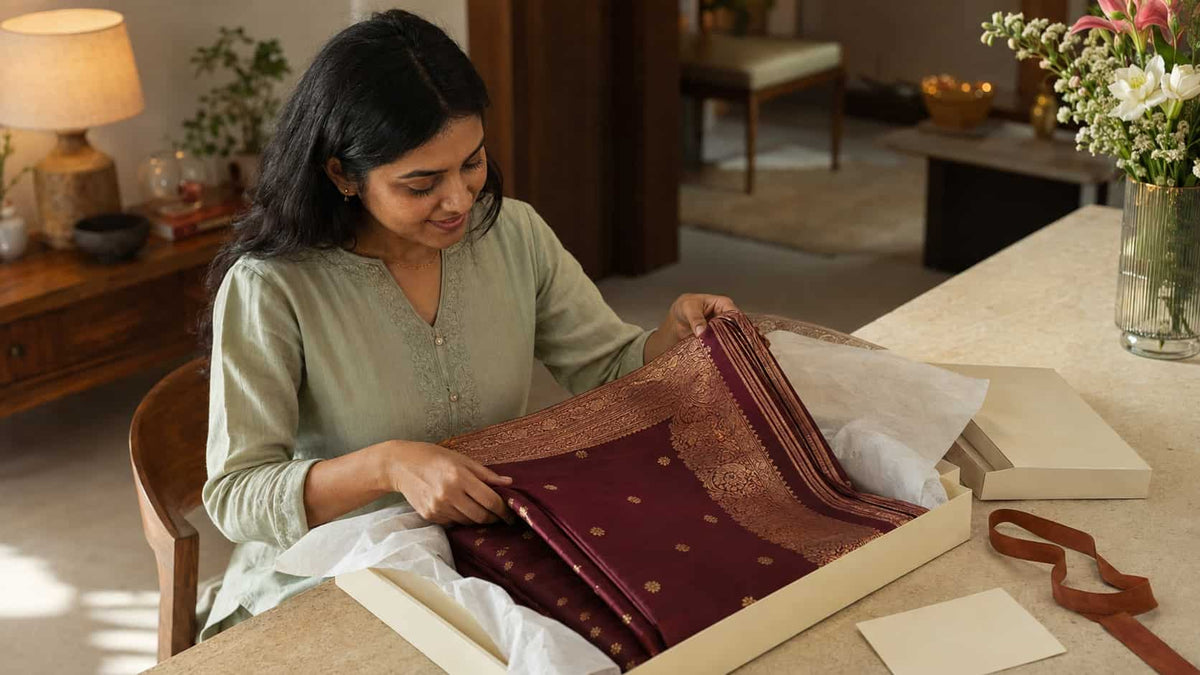
Presentation should protect the saree and communicate why you chose it. It does not need excessive decoration.
-
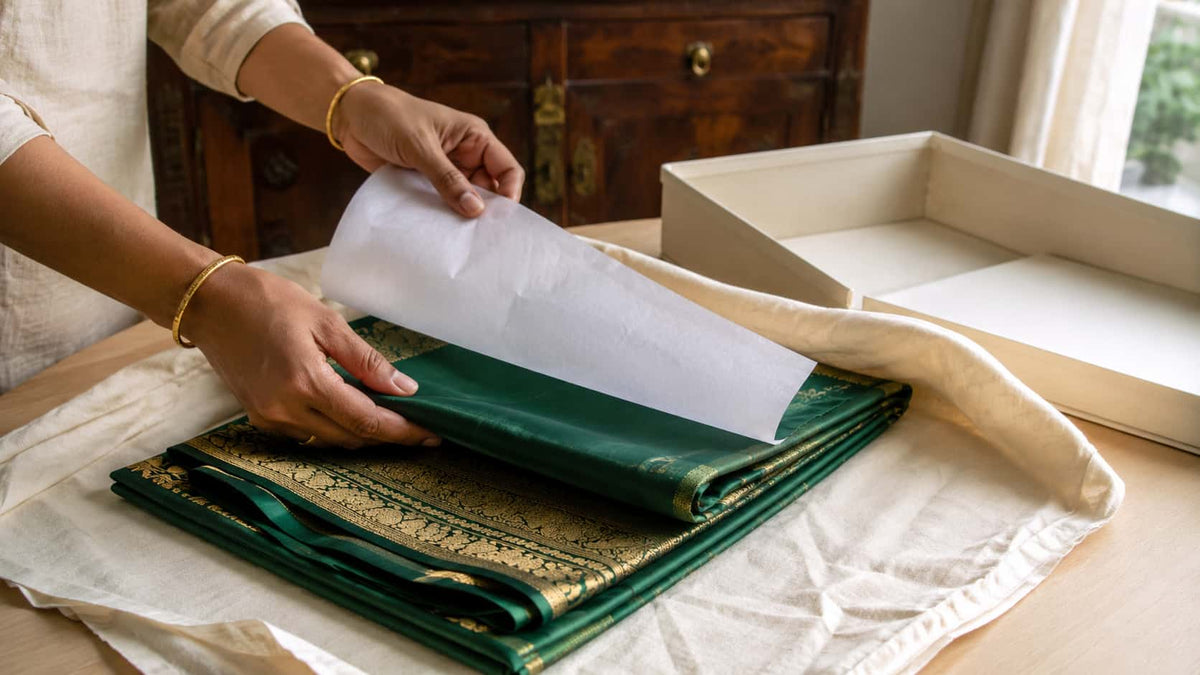
Fold the saree neatly so that its most distinctive border or pallu detail is visible when the box is opened.
-
Place soft tissue or a clean, colourfast cloth between delicate folds to reduce rubbing.
-
Use a sturdy box or fabric pouch appropriate to the saree's weight and structure.
-
Keep the unstitched blouse piece, care instructions and any craft or provenance details together.
-
Add a handwritten note explaining why the colour, weave or occasion reminded you of the recipient.
-
If you include an accessory, choose something small and compatible instead of guessing her jewellery taste.
Keep perfume, moisture, adhesive tape, sharp pins and decorative materials away from direct contact with silk, zari and embroidery. Fresh flowers can look beautiful beside a gift box, but they should not touch the fabric. If the gift is being couriered, use a protective outer package around the presentation box so that practical protection does not depend on the decorative layer.
The most memorable part may be the note. “I chose this blue because it reminded me of the saree you wore at…” feels more considered than a generic festive greeting.
Saree Gifting Mistakes to Avoid
-
Choosing through a relationship or age stereotype instead of observing the recipient.
-
Assuming the most expensive or heavily worked saree is automatically the most meaningful.
-
Buying a very sheer, stiff, slippery or heavy saree for someone unfamiliar with that fabric.
-
Ignoring climate, event duration and dry-cleaning requirements.
-
Selecting colour only through trends or universal “auspicious colour” lists.
-
Forgetting to confirm dimensions and whether a blouse piece is included.
-
Stitching or altering the blouse before measurements and preferences are known.
-
Ordering too close to the occasion to inspect or prepare the saree properly.
-
Ignoring current delivery, sale, return and exchange terms.
-
Allowing pins, tape, perfume, moisture or flowers to touch delicate fabric.
Most gifting mistakes come from choosing what appears impressive instead of what feels appropriate. Return to the recipient's real wardrobe whenever a decision becomes uncertain.
Frequently Asked Questions About Saree Gift Ideas
Which Saree Is Best for Gifting?
The best saree for gifting matches the recipient's wardrobe, draping confidence and likely occasions. Chanderi can provide lighter elegance, Banarasi and Kanjivaram suit more formal or heirloom-intent gifts, and georgette or organza can work for contemporary festive dressing. Assess the specific saree's weight, finish and care rather than choosing by name alone.
What Saree Should I Gift My Mother?
Observe what your mother already wears repeatedly. Choose Chanderi if she prefers lighter elegance, Banarasi if she enjoys formal zari and brocade, or Kanjivaram if she is comfortable with structured ceremonial silk. Avoid assuming that a mother automatically wants the heaviest traditional option.
Which Saree Is Easiest for a First-Time Wearer?
Choose a saree with manageable weight, moderate structure, limited sheerness and a pallu that can be secured easily. Avoid very heavy embroidery or an unfamiliar stiff or slippery finish. Because fabrics vary by weave and finishing, evaluate the actual product rather than relying on one universally “easy” fabric name.
Is Banarasi or Kanjivaram Better as a Wedding Gift?
Neither is universally better. Banarasi offers several silk bases and can range from structured Katan to lighter organza or georgette. Kanjivaram generally creates a more structured, border-led ceremonial presence. Choose according to regional preference, recipient comfort, ceremony scale and expected repeat use.
What Saree Colour Is Safest to Gift?
A colour already visible in the recipient's wardrobe is the safest choice. If you cannot check, select a versatile shade with manageable contrast rather than a neon or highly unusual combination. For weddings, pujas and other ceremonies, confirm family or community colour preferences instead of following universal online rules.
Should a Saree Gift Include a Blouse Piece?
An included blouse piece is convenient, but it must be confirmed for the specific saree. Check whether it is attached or separate, its material and approximate length. Keep it unstitched unless you know the recipient's accurate measurements, preferred neckline, sleeves and fit.
How Should I Pack a Saree for Gifting?
Fold the saree carefully, protect delicate folds with soft tissue or clean cloth, and place it in a sturdy box or fabric pouch. Include the blouse piece, care information and any craft details. Finish the gift with a handwritten note, while keeping pins, tape, perfume, moisture and fresh flowers away from the fabric.
A Thoughtful Saree Gift Begins With Attention
The art of festive gifting is not about finding the loudest saree or reaching the highest price. It is about showing that you noticed: the colours she repeats, the fabrics she enjoys, the occasions she attends and the way she likes to feel when dressed.
When recipient, occasion, budget, fabric and presentation support one another, a saree becomes more than a beautiful object. It becomes a gift she can wear, remember and make part of her own story.
Explore Smira's Festive Edit to discover handcrafted sarees for meaningful celebrations and milestone gifts.