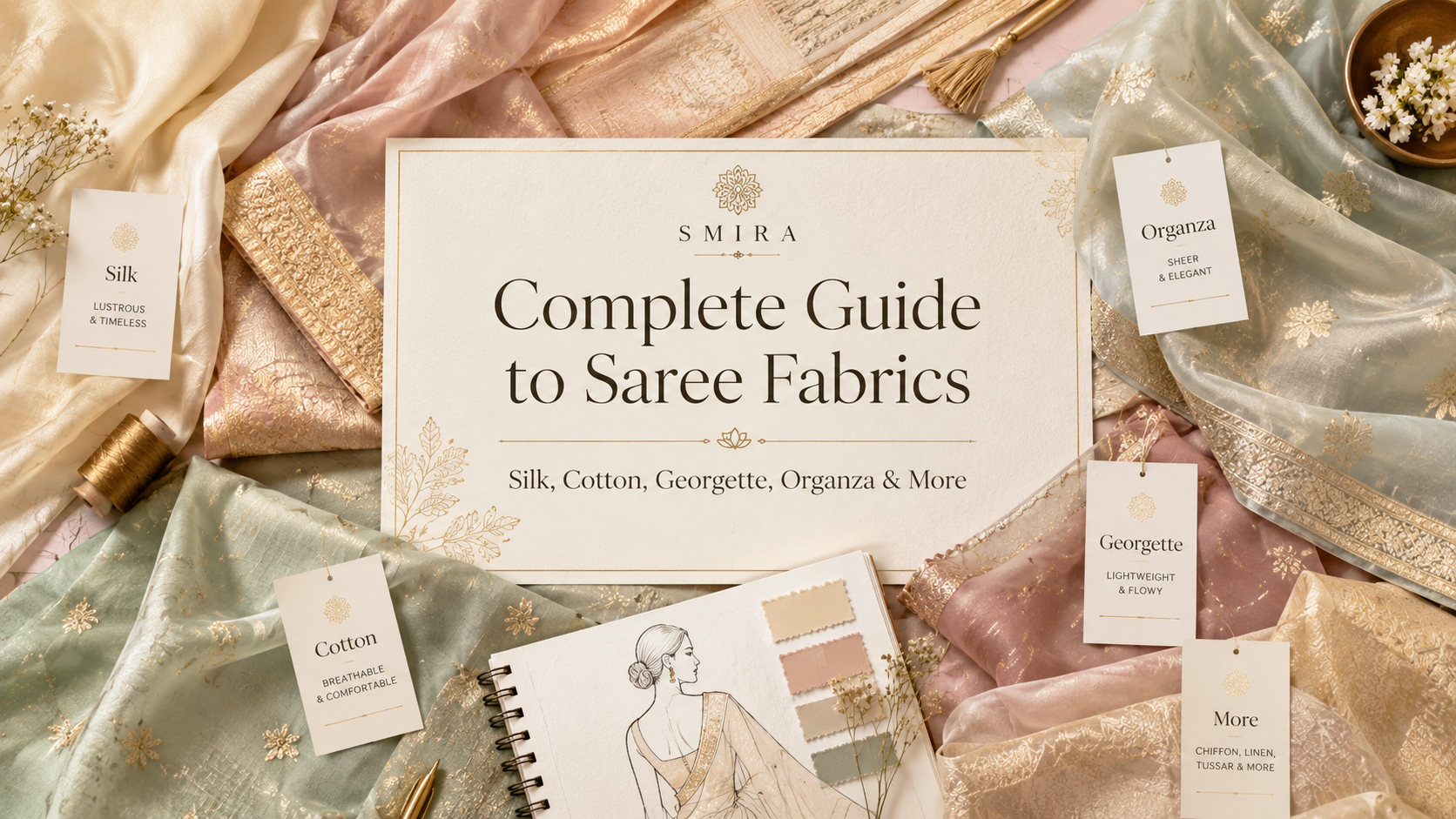
Saree Fabrics Guide: Silk, Cotton, Georgette, Organza & More
Saree is one of the longest continuously worn garments in the world, and the single biggest reason no two sarees feel the same is fabric. The same six yards behave entirely differently when woven from mulberry silk versus mulmul cotton.
Fabric decides how a saree falls on the body, how it photographs, how warm or cool it feels, how it ages over twenty years in your wardrobe, and how much you should expect to spend.
This guide is built for buyers who want to make an informed choice — whether you're buying your first saree, planning a trousseau, or replacing a piece you loved but didn't last. We'll walk through every major saree fabric, compare them across the things that actually matter when wearing one, and help you match material to occasion.
How to Read a Saree Fabric (Before We Get to Specific Materials)
Three properties matter more than the fabric's name:
Weight — measured in grams per square metre (GSM), ranges roughly from 30 GSM (whisper-thin chiffon, organza) to 600+ GSM (bridal Kanjivaram). Heavier doesn't mean better; it means structured.
Drape — how the fabric falls when pleated. Fluid drapes (georgette, chiffon, satin) cling and move with the body. Structured drapes (Kanjivaram, organza, tissue) hold pleats and a wider silhouette.
Weave — plain, satin, twill, jacquard, brocade. The weave determines surface texture and how light catches the fabric. A silk Banarasi gleams; a silk Tussar has a dry, textured matte finish — both are silk.
A useful shorthand: fluid fabrics flatter movement; structured fabrics flatter formal occasions and standing-still photographs.
The Major Saree Fabrics
1. Silk
Silk is the prestige fabric of the saree world, but it isn't one material. Indian silks vary so much by region that two "pure silk" sarees can feel like entirely different cloths.
Kanjivaram (Kanchipuram)
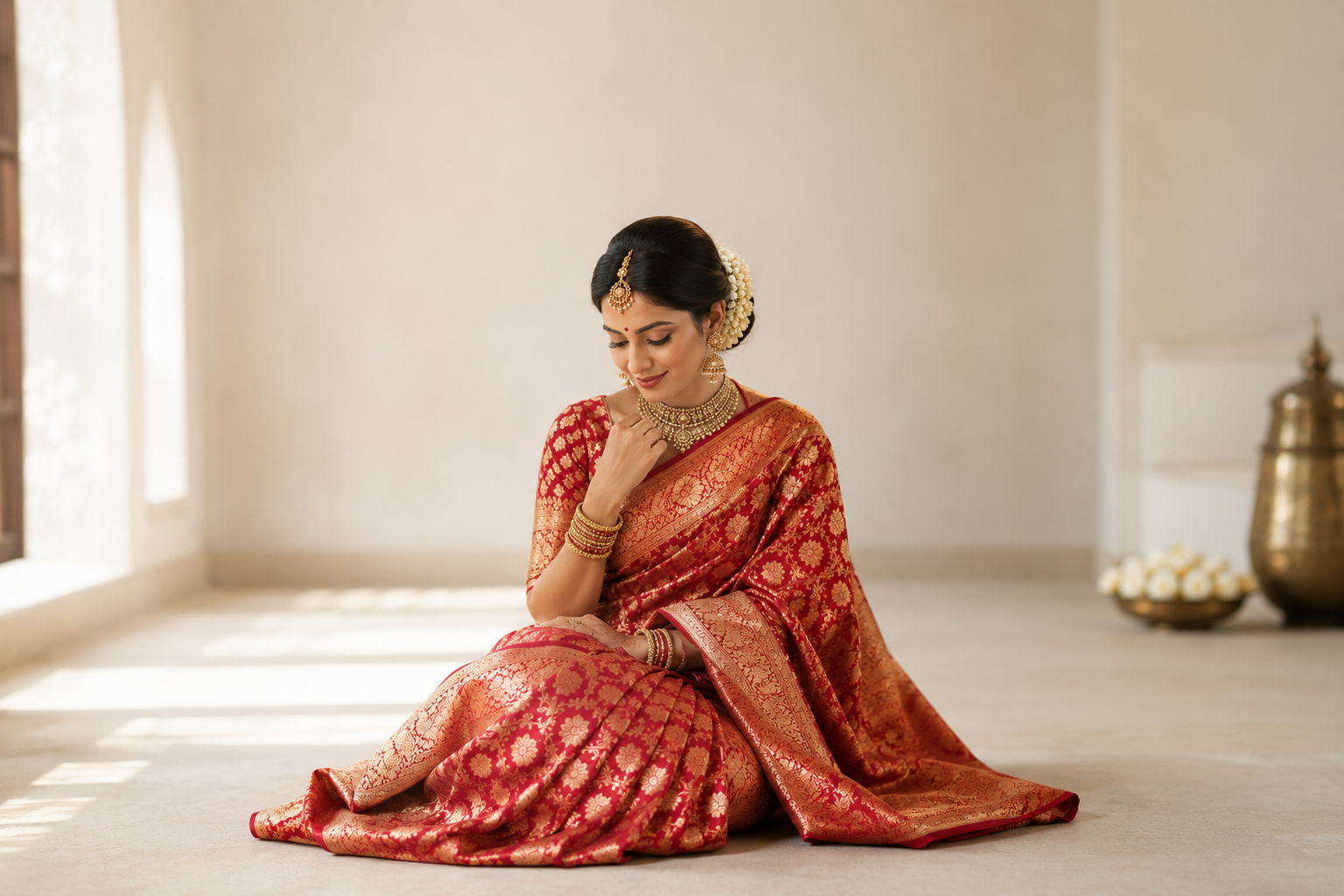
Heavy mulberry silk from Tamil Nadu, traditionally woven with three threads in the body and contrast borders woven separately and attached at the join (the korvai technique). Famous for zari work in gold or silver. Weight 500–900 GSM. Best for weddings — your own or someone else's. Holds shape, photographs beautifully, lasts generations.
Banarasi
From Varanasi, characterised by Mughal-influenced motifs (paisley, jhallar, kalga-bel) and dense brocade work. Lighter than Kanjivaram in most cases. Available in pure silk (katan), silk-cotton blends, and the lighter organza-base Banarasi. Versatile for receptions, sangeets, and dressier festive wear.
Mysore Silk
A KSIC-protected fabric from Karnataka — pure mulberry silk with 100% gold zari options. Softer drape than Kanjivaram. Less ornate, more "everyday luxury" — Pongal, Onam, work celebrations, day weddings.
Tussar (Tussah)
Wild silk with a coarse, gold-toned natural texture. Lighter and more matte than mulberry silk. Cooler to wear. Pairs beautifully with hand-painted Madhubani or Kalamkari motifs and tribal weaves. Excellent for summer formal events.
Chanderi
Technically a silk-cotton or silk-zari blend from Madhya Pradesh, but worth mentioning here because of its translucent, glossy finish. Featherweight (around 80–150 GSM). The saree that wears like an idea.
Patola, Paithani, Baluchari, Pochampally
Regional silk weaves, each with a protected origin and a distinct visual language. Patola is double-ikat from Gujarat. Paithani has the tapestry-woven pallu of Maharashtra. Baluchari narrates entire scenes in its pallu. Pochampally uses ikat-resist tie-dye.
Price range: ₹3,000 (entry Mysore, light Banarasi) to ₹2,00,000+ (bridal Kanjivaram with heavy zari).
2. Cotton
Cotton is the everyday saree of the subcontinent — and increasingly, an aesthetic choice for buyers who want a quieter, more lived-in look.
Handloom Cotton
Woven on pit looms by weavers in Bengal, Odisha, Andhra Pradesh, and Tamil Nadu. Breathable, structured enough to pleat cleanly, soft enough to crush. Sub-categories include Jamdani (Bengal, woven motifs), Sambalpuri (Odisha ikat), Venkatagiri (Andhra, fine zari borders), and Kanjivaram cotton.
Mulmul (Muslin)
Featherweight cotton, historically the cloth that passed through a finger ring. Sheer, soft, made for hot summers. Drapes beautifully but creases freely.
Khadi
Hand-spun, hand-woven. Rougher texture, slubby surface, gets softer with every wash. The intentional, slow-fashion choice.
Cotton-Silk Blends
Maheshwari (Madhya Pradesh) and Chanderi cotton-silks combine the breathability of cotton with the sheen of silk. The most wearable category for Indian summers and offices.
Price range: ₹800 (mill cotton) to ₹15,000+ (fine Jamdani).
3. Georgette
A lightweight, slightly crinkly fabric — originally pure silk, today most market georgette is polyester or viscose-georgette — with excellent fluid drape.
Weight 60–100 GSM. Drapes close to the body without clinging the way satin does. Forgiving — doesn't crease the way silk does, doesn't need ironing as desperately as cotton. Photographs well in movement, which is why it's the default for choreographed events: sangeets, cocktail parties, mehndis.
Pure silk georgette drapes with more weight and costs significantly more. Faux georgette is the workhorse — affordable, easy, and machine-washable in many cases.
Price range: ₹1,200 (synthetic) to ₹40,000+ (designer pure silk georgette).
4. Chiffon
Chiffon is georgette's younger sister — even lighter, more transparent, slipperier. Where georgette has a faint crinkle, chiffon is smooth. It drapes in long fluid lines, the kind that flutter on camera.
The classic "Bollywood saree" of the '70s and '80s — pastel chiffons with sequin borders — is having a steady revival. Chiffon is also the easiest fabric for first-time wearers to drape because it's so light, though that same lightness means it slips off the shoulder readily; a saree pin is non-negotiable.
Price range: ₹1,500 to ₹25,000.
5. Organza
Crisp, transparent, structured. Organza is the architecture fabric — it holds its shape, ruffles, stands away from the body. Silk organza is the premium version; polyester organza is everywhere now and visually similar at a fraction of the price.
Weight 30–60 GSM despite the structure (it's the weave, not the mass, that creates body). Excellent for layering — many modern designers use organza pallus over a different-fabric body. Crushes if folded for storage; needs to hang.
Wears beautifully for day weddings, brunches, engagements, and any occasion where the saree itself is the statement.
Price range: ₹2,500 (poly organza) to ₹50,000+ (silk organza with hand-embroidery).
6. Linen
Linen sarees are a relatively recent entry into Indian formal wear, popularised in the last two decades for office wear and minimal aesthetics. Made from flax, linen has a dry, slightly stiff hand that softens with washing. Breathable like cotton but with a subtle sheen and a crisper drape.
It wrinkles aggressively. This is part of the aesthetic — linen looks intentional in its creases — but it's worth knowing before you buy. Linen-cotton and linen-silk blends address the creasing somewhat.
Price range: ₹2,000 to ₹15,000.
7. Crepe
Crepe describes a finish rather than a single fibre — silk crepe, polyester crepe, and crepe de chine all share the same slightly pebbled, matte surface. Drapes heavier than chiffon, lighter than satin. Doesn't crease easily, which makes it travel-friendly.
Crepe is the underrated workhorse of formal saree wardrobes. Subtle sheen, fluid fall, and it takes printing and embroidery exceptionally well. Common in designer print sarees and minimal-aesthetic offerings.
Price range: ₹1,500 to ₹35,000.
8. Net
Net is a mesh fabric, almost entirely transparent, used for sarees that lean party-wear and lehenga-style draped sarees. Almost never worn without embellishment — sequins, stones, beadwork, or embroidery — because the fabric itself is barely there.
Lightweight but not always comfortable: rough against bare skin without a soft lining, and prone to snagging on jewellery.
Price range: ₹2,500 to ₹40,000+.
9. Velvet
Heavy, pile-surfaced, winter-formal. Velvet sarees are a winter wedding fabric in North India — Delhi, Punjab, Lucknow. Warm to the point of being unwearable in southern climates or summer events. Drapes with significant weight and holds intricate zardozi and dabka work beautifully.
Price range: ₹6,000 to ₹1,00,000+.
10. Satin
Smooth, shiny, fluid. Satin is a weave, not a fibre — satin can be silk-satin (premium) or polyester satin (common). The defining feature is the glossy face produced by floating warp threads. Drapes very close to the body.
Satin sarees photograph well under low light (the sheen catches everything), which is why they're popular for evening receptions and cocktail events. Less forgiving on the body than georgette because it follows every contour.
Price range: ₹1,800 to ₹30,000.
Saree Fabric Comparison Table
| Fabric | Weight | Drape | Best Occasion | Care | Price Range (INR) |
|---|---|---|---|---|---|
| Kanjivaram Silk | Heavy | Structured | Weddings | Dry clean only | ₹15,000 – ₹2,00,000+ |
| Banarasi Silk | Medium–Heavy | Structured | Receptions, festivals | Dry clean | ₹5,000 – ₹1,50,000 |
| Tussar Silk | Medium | Semi-structured | Day events, formal | Dry clean | ₹4,000 – ₹40,000 |
| Chanderi | Light | Semi-fluid | Festive, casual luxe | Gentle hand-wash / dry clean | ₹2,500 – ₹25,000 |
| Cotton (Handloom) | Medium | Crisp | Daily, work, summer | Machine-wash gentle | ₹800 – ₹15,000 |
| Mulmul Cotton | Very Light | Fluid | Summer casual | Hand-wash | ₹1,000 – ₹6,000 |
| Georgette | Light | Fluid | Sangeets, parties | Hand-wash / dry clean | ₹1,200 – ₹40,000 |
| Chiffon | Very Light | Very Fluid | Cocktails, evening | Hand-wash gentle | ₹1,500 – ₹25,000 |
| Organza | Light | Structured | Day weddings, brunches | Dry clean, hang | ₹2,500 – ₹50,000 |
| Linen | Medium | Crisp | Office, day formal | Machine-wash gentle | ₹2,000 – ₹15,000 |
| Crepe | Medium | Fluid | Versatile formal | Hand-wash / dry clean | ₹1,500 – ₹35,000 |
| Net | Very Light | Fluid | Parties, receptions | Dry clean | ₹2,500 – ₹40,000 |
| Velvet | Heavy | Structured | Winter weddings | Dry clean only | ₹6,000 – ₹1,00,000+ |
| Satin | Medium | Very Fluid | Evening, cocktail | Dry clean | ₹1,800 – ₹30,000 |
How to Choose a Saree Fabric by Occasion
For your own wedding (ceremony) — Kanjivaram, Banarasi, or Paithani silk. The occasion calls for a fabric that holds heirloom value.
For someone else's wedding (as a guest) — Banarasi, silk-georgette, organza, or Chanderi. Festive without competing with the bride.
For a sangeet or mehndi — Georgette, chiffon, light Banarasi, or organza. You'll be moving; the fabric should move with you.
For an office or work event — Linen, cotton handloom, Chanderi cotton-silk, or crepe. Restrained, breathable, no embellishment overload.
For a festival (Diwali, Karva Chauth, Onam) — Mysore silk, Banarasi, Tussar, or Chanderi. Festive but not bridal-tier.
For summer wear — Mulmul, handloom cotton, Tussar, linen, Chanderi. Anything with breathability and natural fibre.
For winter wedding receptions — Velvet, heavy Banarasi, Kanjivaram. Fabric that doesn't need a shawl.
For everyday wear — Handloom cotton, Khadi, mulmul, soft silk-cotton blends.
Caring for Your Saree by Fabric
Saree care is the single biggest predictor of how long a piece lasts. The rules differ by fabric:
Pure silks (Kanjivaram, Banarasi, Mysore) — Dry clean only, and only when actually soiled (over-cleaning damages zari). Store folded in soft muslin cloth, refolded along different lines every 3–6 months to prevent permanent creases. Never hang heavy silks — the weight stretches the fabric.
Tussar silk — Dry clean preferred; some pieces tolerate gentle cold hand-wash with mild detergent. Always air-dry in shade.
Cotton (handloom, mulmul, khadi) — Machine-wash on gentle, or hand-wash. The first wash should be cold water with salt to set the dye. Iron while damp.
Georgette and chiffon — Hand-wash with mild detergent, or dry clean. Don't wring; press water out gently. Dry flat or on a padded hanger.
Organza — Dry clean. Hang to store; folding creates creases that are very hard to iron out.
Linen — Machine-wash on gentle the first time to allow shrinkage, then hand-wash subsequently. Iron damp for the crispest finish, or embrace the wrinkles.
Velvet — Dry clean only. Store rolled, not folded — folding crushes the pile permanently along the crease.
Net and embellished sarees — Dry clean. Store flat in a cloth bag with tissue padding between embellished sections.
Universal rules — Keep silver and gold jewellery away from stored sarees (tarnish transfers), avoid plastic storage (traps moisture), and refold heavy pieces periodically.
How to Tell a Pure Fabric from a Blend
A few practical checks before you buy, especially in markets:
The burn test — Pure silk burns slowly, smells like burnt hair, and leaves a brittle ash. Polyester melts into a hard plastic bead. (Ask the seller to burn a single thread from the pallu fringe.)
The ring test — Pure mulberry silk and fine mulmul will pass through a finger ring. Blends usually won't, though this isn't definitive for heavier weaves.
Weight versus appearance — A 600-gram "Kanjivaram" at ₹5,000 is not a pure silk Kanjivaram. Pure silk has a price floor set by raw material cost.
Sound — Pure silk produces a faint rustle (called scroop) when crushed. Polyester is silent or makes a plasticky crinkle.
GI tag and certification — Kanjivaram, Banarasi, Pochampally, Paithani, Chanderi, and several others have Geographical Indication tags. Reputable sellers will provide certification or weave-mark documentation.
Frequently Asked Questions
Which saree fabric is best for beginners? Chiffon or georgette. They drape with minimal weight, forgive uneven pleats, and don't crease as visibly. A pre-stitched or ready-to-wear saree in either fabric is the gentlest entry point.
Is a silk saree comfortable in summer? Mulberry silks like Kanjivaram and Banarasi are warm. Tussar silk and Chanderi are summer-appropriate silks because of their lighter weight and looser weave.
What's the difference between georgette and chiffon? Georgette is heavier, slightly crinkled, and has more body. Chiffon is lighter, smoother, and more transparent. Chiffon drapes more dramatically; georgette holds pleats better.
Are polyester sarees worth buying? For occasion wear you'll use a few times — yes, especially polyester georgettes and organzas. For long-term wardrobe staples, natural fibres age better and feel better on the skin.
How much should I spend on my first silk saree? For a first silk that you'll wear to weddings and festivals, ₹8,000–₹20,000 buys a quality Banarasi, Mysore silk, or light Kanjivaram. Below ₹5,000, you're usually looking at blends marketed as silk.
What fabric is best for a pre-stitched saree? Crepe, georgette, and satin pleat well and hold their shape in pre-stitched constructions. Stiff fabrics like organza and structured silks are harder to engineer for ready-wear.
How do I store sarees long-term? Cotton muslin bags, refolded every 3–6 months, in a dry cupboard away from direct sunlight. Avoid plastic. Add a small sachet of dried neem leaves or cloves as a natural moth deterrent.
Choosing Your Next Saree
The right saree fabric is the one that matches where you're going to wear it, what you want it to do for your body, and how long you want it to last. A wardrobe with one Banarasi, one Chanderi, one linen, and a couple of cottons covers most of an Indian woman's calendar — wedding, festival, work, summer evening, casual brunch.
At Smira, our collections are organised by fabric for exactly this reason — once you know what material you want, choosing a saree becomes a question of colour and motif rather than guesswork. Browse our handloom cottons for daily wear, our silks for occasions, and our georgettes and organzas for the moments in between.