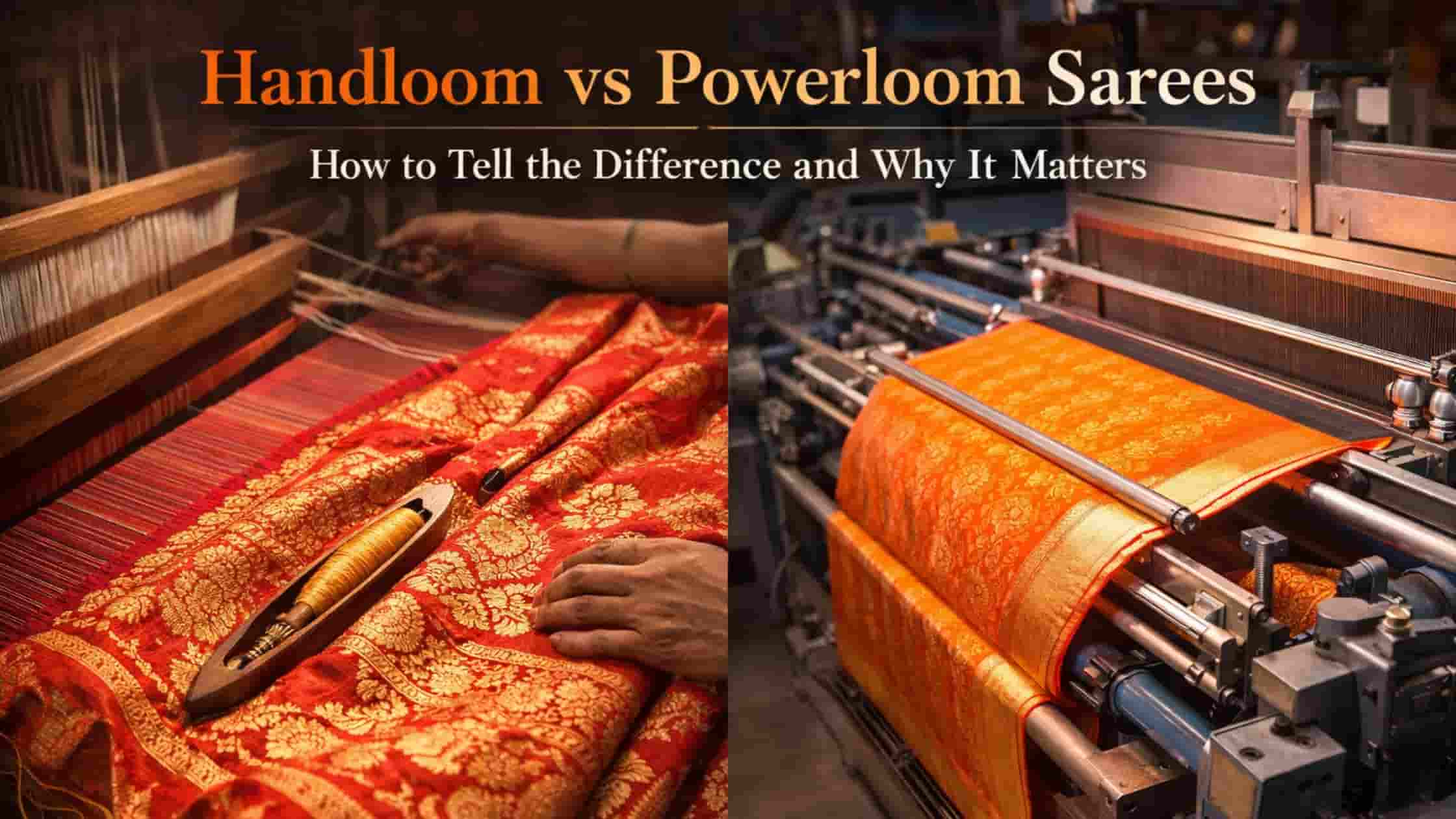
Handloom vs Powerloom Sarees: What Changes Craft by Craft and How to Tell the Difference
You have probably read the advice before. Check the reverse side. Look for pin marks. Feel the texture. Ask about the price.
Because what a handloom Banarasi looks like on the reverse is entirely different from what a handloom Chikankari looks like. The tells in a Chanderi are not the same as the tells in a Kanjivaram. Generic advice gets you halfway. Craft-specific knowledge gets you there.
This guide does not treat all sarees as one. It takes you through the handloom vs powerloom distinction in the crafts that matter most — so that when you are holding a saree in your hands, or scrolling through images online, you know exactly what you are looking at and what questions to ask.
Why This Distinction Matters More Than Most Buyers Realise
A powerloom saree is not automatically a bad saree. But it is a fundamentally different object from a handloom one — not just in how it was made, but in what it is made of, what it does on the body, and what it is worth over time.
Here is what actually changes when a saree moves from handloom to powerloom:
The fibre changes. Handloom weaving requires yarn of a certain twist, weight, and pliability to work with a human-operated loom. This naturally favours pure silk, pure cotton, and natural silk-cotton blends. Powerloom production favours yarns with consistent synthetic properties — polyester, viscose, art silk — because they behave predictably at high speed. Many powerloom sarees marketed as "silk" or "Banarasi silk" use blended or synthetic yarns to hit a price point. The GI tag and Silk Mark exist specifically because this substitution is so widespread.
The weave structure changes. On a handloom, every thread is placed by a human being who is reading the pattern, adjusting tension, and making micro-decisions that a machine cannot. This creates a weave with natural variation in density — slightly tighter here, slightly looser there — that gives the saree its characteristic softness and drape. A powerloom weave is mechanically uniform, which makes it visually cleaner but physically stiffer.
The motifs change. Handloom motifs are woven into the structure of the fabric — they exist in the interlacing of the threads themselves. Powerloom motifs are often either jacquard-programmed approximations of traditional designs, or printed after weaving, or created using extra synthetic threads that sit above the base fabric rather than being part of it. The visual difference can be subtle at a distance. The tactile difference is immediate.
The drape changes. This is the one that every experienced saree wearer notices but finds hard to explain. A handloom saree, once draped, moves with the body — it follows, adjusts, breathes. A powerloom saree in a synthetic blend tends to hold its own shape, creating a slightly stiff, structured silhouette that can look beautiful but feels different on the skin, especially across a long day.
Handloom vs Powerloom: What to Look For in Each Craft
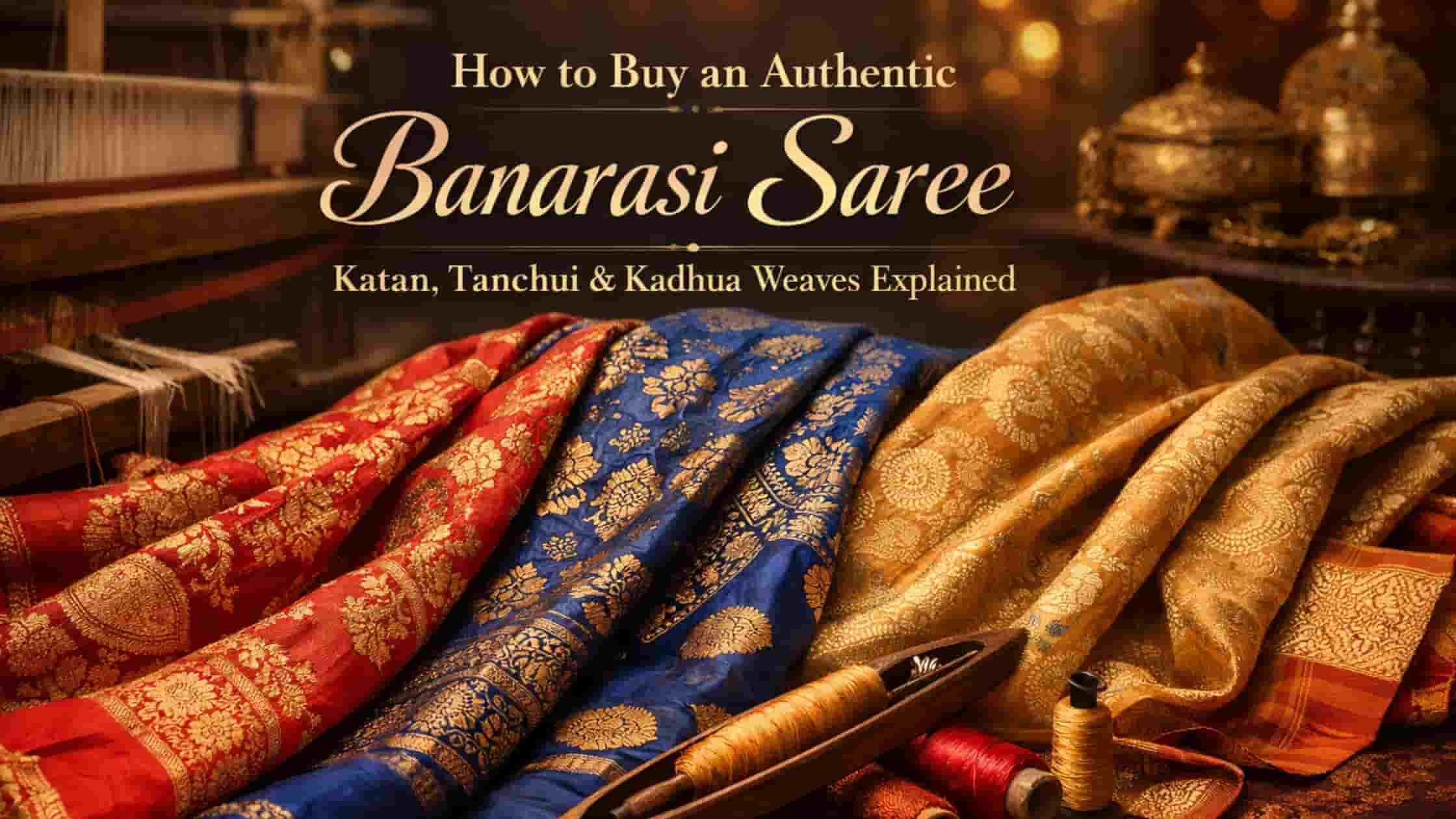
In a Banarasi Saree
The Banarasi is the craft most widely counterfeited by powerloom production, and therefore the one where the distinction matters most financially.
What genuine handloom Banarasi looks like:
Turn the saree over. In a handwoven Banarasi, the reverse will show the structural evidence of how the pattern was made. If it is a Kadhua weave, the back will be clean and almost mirror-like — each motif woven individually with its own shuttle, leaving no loose threads. If it is a Cutwork (Phekwa) weave, you will see small trimmed thread ends at the back of each motif — this is still authentic handloom, just a different technique.
What you should not see on a genuine handloom Banarasi: a perfectly flat, smooth back with no variation whatsoever. A powerloom Banarasi has a uniformly clean reverse because the machine does not change its behaviour from one motif to the next.
The zari in a handloom Banarasi is wrapped around real silk or copper, giving it natural weight and a warm, slightly muted glow. Powerloom Banarasi imitations typically use metallised polyester thread — brighter, lighter, and with a sharp flat shine that looks different in natural light.
Feel the selvedge — the woven edge of the saree. On a handloom piece, the selvedge has a slightly irregular, textured finish with the characteristic small marks left by the pins that held the saree taut on the loom during weaving. Powerloom selvedges are machine-cut or machine-finished and perfectly uniform.
Price as a signal: A genuine handloom Banarasi in pure Katan silk begins at approximately ₹15,000. Lighter weaves like Georgette Banarasi begin around ₹8,000–₹10,000. A "Banarasi saree" offered at ₹2,000–₹4,000 is a powerloom piece, regardless of what the label says.
In a Chikankari Saree
Chikankari is different from Banarasi in a fundamental way: the embroidery is worked by hand after the base fabric is woven, not during weaving. This changes how you evaluate it.
A genuine handcrafted Chikankari saree involves two layers of artisan work. First, the base fabric — traditionally cotton, and in finer pieces, pure silk, georgette, or organza — is woven, often by handloom. Then the embroidery design is transferred onto the fabric and worked entirely by hand by embroiderers in Lucknow, using any of the tradition's forty-plus distinct stitches.
What genuine Chikankari looks like:
The stitches in authentic hand-done Chikankari are slightly uneven — not sloppy, but human. Each petal of a flower will have the same basic shape but not exactly the same tension. This is the mark of a needle in a hand. Machine embroidery produces stitches of identical length, spacing, and tension throughout. This mechanical perfection is, paradoxically, the sign of the lesser piece.
On the reverse of an authentic Chikankari saree, the embroidery threads are neatly knotted and cut close to the fabric. Machine embroidery on the reverse shows the locking stitches of the machine — a different visual signature. The two look quite different once you know what to look for.
The base fabric matters enormously in Chikankari. Traditional Chikankari on pure silk has a translucence and movement that the embroidery plays against beautifully — the white or tonal thread sinks slightly into the silk and creates a soft-relief effect. Chikankari on synthetic georgette or polyester blends has a slightly plastic flatness to it, and the fabric tends to pull slightly around the embroidery points rather than accepting them softly.
What to ask: Where is this embroidered? Authentic Lucknowi Chikankari is worked by artisan communities in Lucknow, Uttar Pradesh. A brand that knows their Chikankari will tell you this. One that does not should prompt the question.
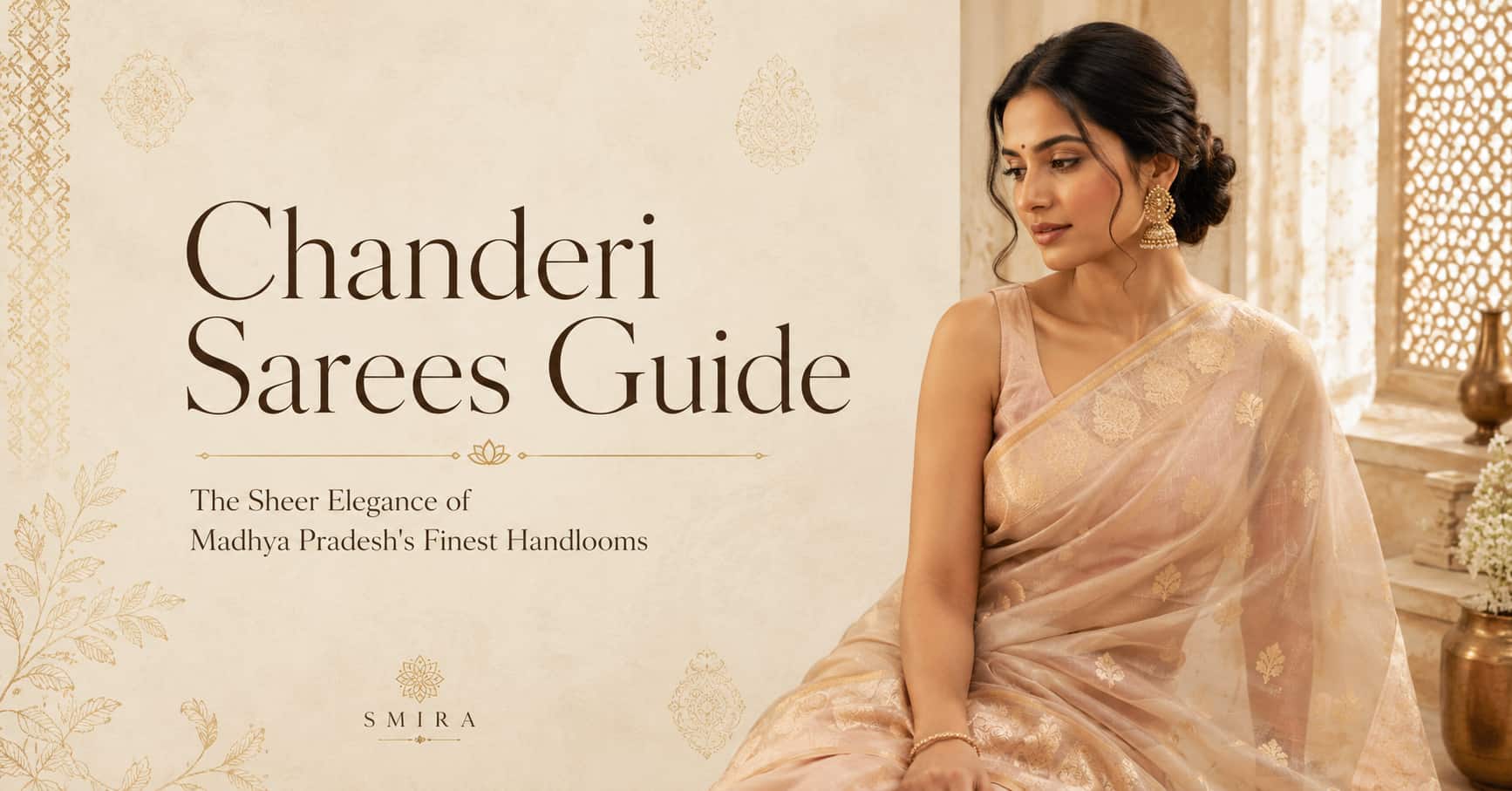
In a Chanderi Saree
Chanderi — the sheer, luminous silk-cotton blend from Madhya Pradesh — is one of the most quietly complex weaves in India. What makes it beautiful is also what makes it easy to fake: its lightness and translucence can be mimicked reasonably well by synthetic organza or power-loom poly-silk blends at a fraction of the price.
What genuine handloom Chanderi looks like:
Authentic Chanderi is woven from a combination of silk warp and cotton weft threads, creating its characteristic quality of being simultaneously light and slightly crisp. When you hold it up to light, genuine Chanderi has a very specific kind of translucence — warm, with a faint golden or ivory undertone from the silk. Synthetic imitations tend to look cooler and more flatly sheer, like plastic film.
The zari borders and motifs in handloom Chanderi are woven in — they are part of the weave structure, not applied on top. Run a fingernail gently across the border: in a genuine piece, the zari sits flush with or barely above the fabric surface because it is structurally integrated. In a powerloom imitation, applied zari or jacquard zari tends to sit more visibly above the base, and can catch and pull if dragged.
The body of an authentic Chanderi has a subtle, natural slubbing — slight variations in the thickness of the thread that create an organic texture when held to light. These are not defects. They are the characteristic of a manually spun and handloom-woven natural yarn. Powerloom Chanderi imitations in synthetic blends are perfectly smooth and uniform throughout.
The drape of genuine Chanderi is extraordinary — it flows and gathers with almost no resistance. Synthetic Chanderi-style fabrics have a slightly stiffer memory and do not gather as cleanly.
The Five Tests That Work Across Every Craft
While each craft has its own specific tells, these five tests apply universally when evaluating any saree.
1. The reverse side. This is the single most reliable test. Flip the saree and look at the back. Handloom weaves will show thread variation, natural joins, and the structural logic of the weaving pattern. The more uniform and machine-clean the reverse, the more likely you are looking at powerloom. The specific appearance will vary by craft — refer to the craft-specific sections above for what to expect.
2. The selvedge. The woven edge of a handloom saree carries small pin holes at regular intervals — marks left by the loom pins that held tension during weaving. These appear on the inner border edge, not the decorative edge. Their presence is one of the clearest signs of handloom weaving. A powerloom saree has a mechanically finished or cut selvedge with no such marks.
3. The light test. Hold the saree up to natural light. A handloom saree in pure natural fibre has a warmth and depth to its translucence. You may see the thread structure, the variation in weave density, the natural slubbing of the yarn. A synthetic powerloom weave looks flat and plastic against light — it does not have the same optical depth.
4. The gather test. Gather a section of the saree loosely in your palm. A handloom saree in natural silk or cotton will collapse softly and release cleanly. A powerloom saree in a synthetic blend will resist slightly, feel stiffer in the gather, and may hold a slight crease where it was folded.
5. The price and the story. Handloom weaving is slow. A Banarasi saree can take weeks to months. A Chanderi takes days. A Chikankari saree can involve dozens of hours of hand embroidery. None of this is compatible with a ₹2,000 price point. And a brand that genuinely works with handloom artisans will tell you — without prompting — where the saree was woven, by whom, and in what technique. That knowledge is not incidental to the product. It is the product.
Why It Matters Beyond the Saree Itself
When you buy a genuine handloom saree, the transaction reaches beyond your wardrobe.
India has over 43 lakh handloom weavers — the second largest employment group in the country after agriculture. Handloom weaving is not a heritage curiosity. It is a living economy, concentrated in communities in Varanasi, Lucknow, Chanderi, Kanchipuram, and dozens of other textile towns, where families have woven on the same looms for generations.
The powerloom industry has put significant pressure on this economy. A powerloom can produce 5 to 25 metres of Banarasi-style fabric in a single day. A handloom weaver producing a complex Katan silk saree may weave 10 to 80 centimetres in the same time. When a powerloom saree is sold as "handloom" — which happens routinely — it displaces not just a product but a livelihood.
Choosing handloom deliberately, and knowing how to verify what you are buying, is therefore not only a matter of personal taste or quality. It is a concrete act of support for a craft ecosystem that has survived for centuries and is worth protecting.
At Smira, every saree in our collection is handcrafted in pure natural fibres. We work with Banarasi weavers, Chikankari embroiderers, and Chanderi artisans — and we describe the weave, the fabric, and the craft origin of every piece clearly, because we believe that knowing what you are wearing changes how you wear it.
Explore our Banarasi Collection →
Explore our Chikankari Collection →
Explore our Chanderi Collection →
Frequently Asked Questions
How do I tell if a Banarasi saree is handloom or powerloom?
Examine the reverse side — handloom Banarasi weaves show either a clean, motif-specific reverse (Kadhua technique) or characteristic trimmed thread ends at each pattern (Cutwork). The selvedge will carry small loom pin marks. The zari will have natural weight and a warm, muted glow rather than a sharp synthetic shine. Price is also a reliable signal: genuine handloom Banarasi sarees begin at ₹8,000–₹15,000 depending on the weave.
Is Chikankari always handmade?
Authentic Lucknowi Chikankari is hand-embroidered by artisans in Lucknow, Uttar Pradesh. Machine-embroidered imitations exist widely. To distinguish them, look for slight natural variation in the embroidery stitches — perfect uniformity indicates machine work. The reverse of genuine Chikankari will show hand-knotted thread ends, not machine locking stitches.
What does a genuine handloom Chanderi feel like?
Authentic handloom Chanderi has a warmth and organic texture that synthetic imitations lack. It gathers softly in the hand, holds a warm translucence against light, and has slight natural variation in the thread — called slubbing — that is characteristic of naturally spun yarn. Synthetic Chanderi alternatives are uniformly smooth and feel slightly stiffer.
What is the Handloom Mark and what does it certify?
The Handloom Mark is an official certification issued by the Government of India that guarantees a textile was woven on a handloom by a weaver. It is separate from the Silk Mark, which certifies pure silk content. When buying online, look for both — they are independent certifications covering different aspects of the product.
Can powerloom sarees look as good as handloom ones?
At a distance or in a photograph, yes — this is precisely why the confusion exists. The difference becomes clear in person, in the hand, on the body, and over time. A handloom saree in pure natural silk or cotton drapes, breathes, and ages differently from a powerloom equivalent. For a saree you intend to wear once, the difference may feel less pressing. For a saree you intend to keep, pass on, or wear across many occasions, handloom is an investment with no real machine-made equivalent.
Why are powerloom sarees sold as handloom?
Price premium and consumer trust. The handloom label commands significantly higher prices and greater emotional value from buyers. The absence of strong supply-chain transparency in much of the market has historically made misrepresentation easy. This is one reason certifications like the GI tag, Silk Mark, and Handloom Mark exist — and why buying from brands that disclose their sourcing and craft clearly is the most reliable protection a buyer has.
Smira carries only handcrafted sarees in pure natural fabrics — Banarasi, Chikankari, Chanderi, and Kanjivaram — each chosen for the integrity of its weave and the story of the hands that made it. Every product description names the craft, the fabric, and the technique, because we believe you deserve to know exactly what you are wearing.