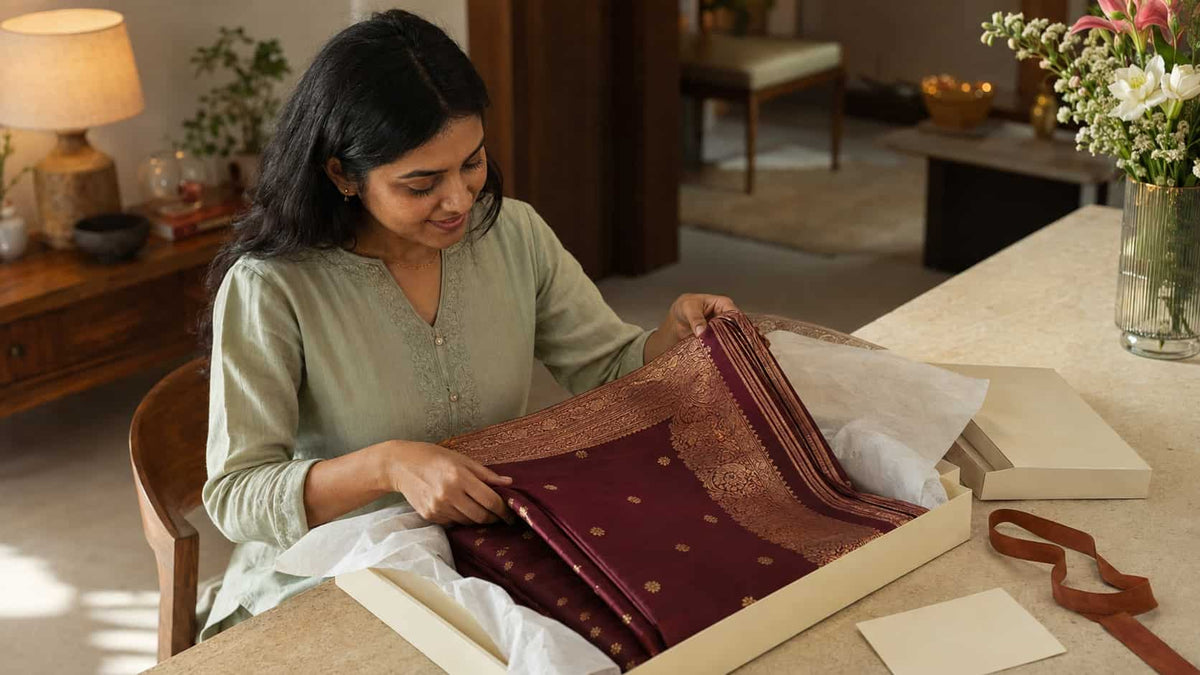
Article: How to Care for Silk Sarees: Cleaning, Ironing and Storage
How to Care for Silk Sarees: Cleaning, Ironing and Storage
A silk saree does not need constant cleaning to remain beautiful. It needs the correct treatment at the correct time.
The safest approach begins with the care instructions provided with the saree. Its silk base, dyes, zari, embroidery, lining and other decorative elements must then be considered together. A cleaning method that works for a plain silk saree may damage one with metallic thread, mukaish, sequins or an unstable dye.
If you are learning how to care for silk sarees, follow this decision sequence:
-
Read the complete care instructions.
-
Examine the zari, embroidery and other details.
-
Determine whether the saree is suitable for professional cleaning or home washing.
-
Respond to stains without rubbing or experimenting.
-
Dry, press and store the saree without heat, moisture or tight folds.
These silk saree care tips will help you protect the colour, structure, pallu and decorative work while avoiding common mistakes that cause irreversible damage.
Silk Saree Care at a Glance
| Situation | Safest Response |
|---|---|
| Lightly worn with no visible stain | Air it in a shaded, well-ventilated room before folding |
| Label says “Dry Clean Only” | Do not wash it at home |
| Label permits hand washing | Use cool water and a cleanser specifically formulated for silk |
| Saree has heavy zari, sequins, mukaish or embroidery | Use a cleaner experienced with silk and decorative textiles |
| Fresh spill | Blot immediately with a clean, dry white cloth |
| Old, oily or unknown stain | Do not use a home treatment; consult a specialist |
| Long-term storage | Store clean and completely dry with padded folds in a dark, stable space |
| Valuable or heirloom saree | Choose professional advice whenever the correct method is uncertain |
The condition of the individual saree matters more than a general rule about its weave.
Why Do Silk Sarees Need Careful Handling?
Silk is a protein fibre that can be affected by excessive heat, strong cleaning chemicals, light, moisture and physical stress. However, the silk fibre is only one part of the saree.
A saree may also contain:
-
Several dyes with different levels of colourfastness
-
Metallic or imitation zari
-
Embroidery, sequins, beads or mukaish
-
A silk, cotton, tissue, organza or georgette base
-
Finishes that create stiffness, shine or texture
-
An attached or separate blouse piece requiring different care
This is why cleaning should be based on the complete saree rather than its main fibre alone. The FTC’s care-labelling guidance similarly emphasises that care instructions should consider the complete garment, including trims and other components.
Light can fade dyes and weaken fibres over time. Moisture may encourage mould and can affect metallic elements. Tight folds place repeated stress on the same areas, while dragging or rough handling can pull threads and distort the weave.
The objective is not to make a silk saree look untouched forever. It is to reduce unnecessary stress while allowing it to be worn and enjoyed.
Should You Dry Clean a Silk Saree or Wash It at Home?
Professional cleaning is the safer default for valuable silk sarees, particularly when they contain zari, embroidery or multiple colours.
Home washing should be considered only when the product instructions explicitly allow it and the saree has no construction detail that makes washing risky.
Choose Professional Cleaning When:
-
The care instructions say “Dry Clean Only”.
-
The saree has heavy zari, mukaish, beads, sequins or dense embroidery.
-
It is a bridal, vintage, heirloom or high-value saree.
-
The dye transfers during a cautious colourfastness check.
-
The saree contains several contrasting colours.
-
The stain is old, oily or of unknown origin.
-
There is no reliable care information available.
-
The saree has previously been damaged or altered.
-
You are uncertain about its fibre, finish or decorative work.
Select a cleaner who has specific experience with silk sarees and zari. Ask how the saree will be cleaned, pressed and packaged. A general bulk-cleaning service may not provide the same care as a specialist familiar with handcrafted textiles.
Point out every visible stain and explain what caused it, if known. Different stains require different treatments, and the cleaner should examine the saree before processing it.
Consider Hand Washing Only When:
-
The care instructions expressly permit hand washing.
-
The saree is lightweight and unembellished.
-
There is no metallic zari or delicate surface work.
-
The fabric is in sound condition.
-
A cautious test shows no immediate colour transfer.
-
A suitable silk cleanser and a large, clean washing space are available.
A hidden colourfastness check is only an additional precaution. Passing one test does not guarantee that every colour, border or decorative thread will remain stable in water.
The word “Dryclean” should not be interpreted as automatic permission to wash the saree at home. Care-labelling systems differ, and the complete wording must be followed. If the instructions are unclear, ask the seller or choose a silk-experienced cleaner.
How to Wash a Silk Saree at Home Safely
Use this method only when hand washing is permitted for the specific saree.
1. Prepare the Saree
Remove loose pins and inspect the saree for stains, pulled threads or weak areas. Do not wash a damaged saree before seeking professional advice.
Test a small, concealed area with a damp white cloth. Stop if colour transfers, the texture changes or a visible ring develops.
2. Prepare Cool Water and a Silk Cleanser
Fill a clean basin with cool water. Add a small amount of cleanser formulated specifically for silk or delicate protein fibres, following the product’s dosing instructions.
Avoid:
-
Regular alkaline laundry detergent
-
Bleach or whitening products
-
Fabric conditioner
-
Dishwashing liquid
-
Vinegar or lemon
-
Enzyme stain removers
-
Shampoo unless the saree maker specifically recommends it
Baby shampoo is frequently suggested online, but formulations vary and may contain fragrance, conditioning agents or other additives. A properly labelled silk cleanser is a more controlled choice.
3. Wash Briefly Without Soaking
Lower the saree into the water while supporting its weight. Move it gently through the water without rubbing, scrubbing or twisting.
Do not leave it soaking. Prolonged immersion can increase the risk of colour movement, water marks and distortion.
4. Rinse at a Consistent Temperature
Drain the wash water and rinse with fresh cool water. Avoid sudden temperature changes.
Continue only until the cleanser has been removed. Do not squeeze the saree into a tight bundle.
5. Support the Wet Fabric
Wet silk becomes heavier and can stretch if lifted from one end. Gather and support the saree with both hands instead of allowing its full weight to hang from a narrow section.
Never wring or twist it.
6. Remove Excess Water With Towels
Place the saree on a clean, colourfast cotton towel. Roll the towel and saree together gently to absorb excess water.
Press lightly without twisting. Repeat with a dry towel if required.
7. Dry in the Shade
Dry the saree away from direct sunlight, heaters and strong airflow. Support as much of its length as possible across a clean, wide surface.
Avoid hanging a wet saree from a thin wire or single narrow rod because its weight can create a severe crease or distort the weave.
Do not tumble dry silk.
How Should You Treat a Stain on a Silk Saree?
The first response to a stain should be simple: blot, identify and stop.
Use a clean, dry white cloth to lift as much of a fresh spill as possible. Press the cloth straight down and lift it away. Repeat with a clean section of the cloth.
Do not rub the mark. Rubbing can spread the stain, disturb the weave and leave a lighter or roughened area.
| Type of Stain | Immediate Response |
|---|---|
| Fresh water-based spill | Blot with a dry white cloth without spreading it |
| Oil, makeup or food | Blot excess material and take the saree to a specialist |
| Perfume or deodorant mark | Stop adding moisture or products and seek professional advice |
| Stain over zari or embroidery | Do not attempt home treatment |
| Old or unknown stain | Photograph it and consult a silk-experienced cleaner |
| Dye transferring onto the cloth | Stop immediately and keep the area dry |
Do not apply salt, talcum powder, vinegar, lemon, baking soda, toothpaste, hairspray or dishwashing liquid. A home treatment can alter the colour or make professional stain removal more difficult.
When taking the saree to a cleaner, explain:
-
What caused the stain
-
When it occurred
-
Whether any product has already been applied
-
Whether the saree has been washed or dry cleaned before
The more accurate the information, the better the cleaner can assess the risk.
How Do You Dry and Iron a Silk Saree?
Allow the saree to dry completely in a shaded, ventilated area. Direct sunlight may fade its colour, while storing or ironing it before it is dry can trap moisture.
Before ironing, read the product instructions.
If ironing is permitted:
-
Turn the saree to its reverse side.
-
Use the lowest suitable silk setting.
-
Place a clean, thin cotton pressing cloth between the iron and the saree.
-
Test a small concealed section first.
-
Lift and press instead of dragging the iron across the fabric.
-
Avoid direct pressure on zari, sequins, embroidery and raised motifs.
-
Allow the saree to cool before folding.
Do not spray water directly onto the saree. Droplets can create visible rings on some silks.
Steam should be used only when the care instructions permit it. Do not direct concentrated steam onto zari or delicate embellishment. If a crease passes through an ornate border or pallu, a professional press is safer than experimenting with extra heat or moisture.
What Should You Do After Wearing a Silk Saree?
The way a saree is handled after each wear can reduce the need for frequent cleaning.
Remove Pins Carefully
Remove safety pins individually rather than pulling the fabric away from them. Check whether a pin has caught any thread.
Avoid leaving metal pins attached during storage. They can mark, rust or place long-term stress on the same point.
Check for Stains
Examine the underarm area, pleats, hem, pallu and border. Fresh stains are easier for a professional to identify and treat than marks discovered months later.
Air the Saree in the Shade
Place the saree in a clean, shaded and well-ventilated room until all body moisture and odour have dispersed.
Do not place it in direct sunlight or return it immediately to an enclosed wardrobe.
Fold It With Clean Hands
Make sure the saree is completely dry before folding. Remove jewellery that could snag the fabric and use a clean surface.
Airing is not a substitute for cleaning when the saree is visibly soiled. It is simply the correct response to a lightly worn, unstained saree.
How to Store Silk Sarees for Long-Term Protection
Correct storage protects a silk saree from light, moisture, pests, dust and repeated fold stress.
Conservation guidance recommends storing textiles clean and dry in a cool, dark location with stable conditions. It also recommends padding unavoidable folds and supporting fragile or heavy textiles. While museum textiles require stricter handling than everyday clothing, these principles are useful for valuable sarees. Canadian Conservation Institute
1. Make Sure the Saree Is Clean and Dry
Never store a damp saree. Moisture trapped inside a fold or box can lead to musty odours, spotting or mould.
If the saree has food, perspiration or another visible stain, have it treated before long-term storage.
2. Use a Breathable Protective Layer
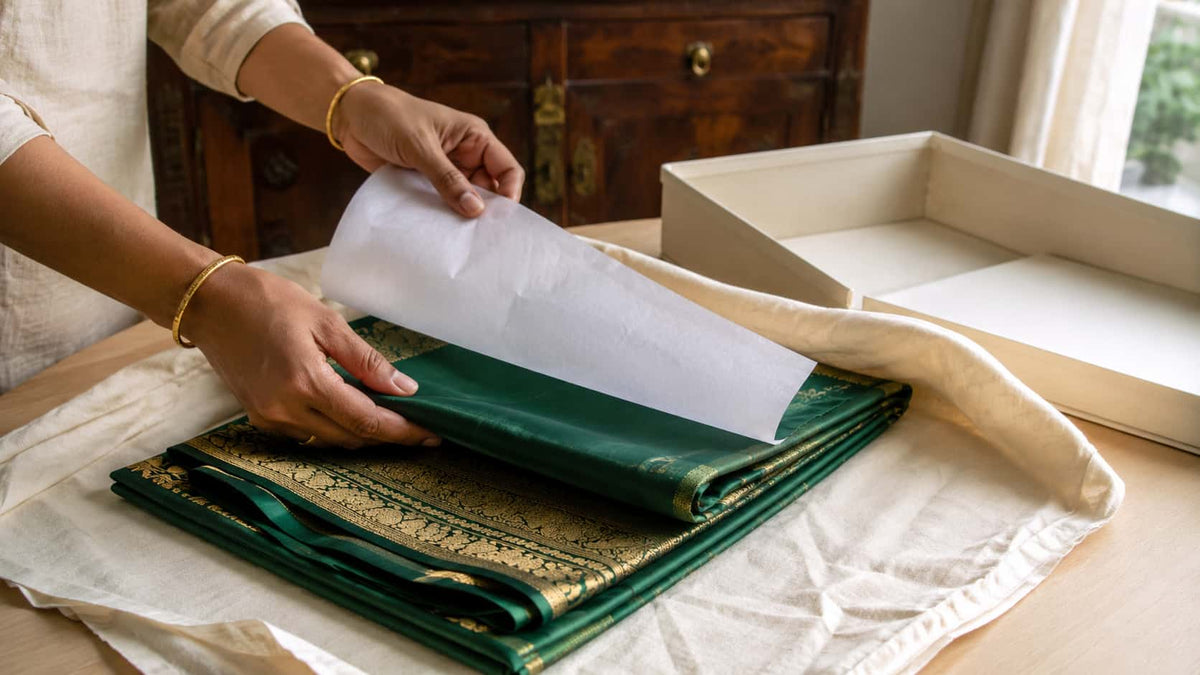
Wrap the saree in washed, unbleached muslin or cotton. Acid-free tissue may be placed between delicate folds, especially around zari borders and heavily worked areas.
Avoid direct contact with:
-
Newspaper
-
Coloured tissue
-
Ordinary cardboard
-
Raw wood
-
Adhesive tape
-
Scented paper
-
Unidentified plastic garment covers
Not every plastic is unsuitable for textile storage. Conservation-grade polyethylene containers can be used correctly. However, thin dry-cleaning covers and unknown plastic saree bags may trap moisture, provide little protection from light or release unwanted odours. A clean muslin wrap inside an appropriate box is a practical home-storage option.
3. Reduce Tight Fold Lines
Fold the saree loosely and pad sharp folds with acid-free tissue or clean muslin. Avoid forcing a heavily worked border into a tight crease.
If sufficient space is available, use as few folds as possible.
4. Store It Flat
Flat storage provides better support than long-term hanging, particularly for heavy sarees.
Avoid stacking many sarees on top of one another. If stacking is unavoidable, place the heaviest saree at the bottom and separate each one with a clean protective layer.
5. Choose a Dark, Stable Location
Keep the saree away from:
-
Direct sunlight
-
Bathrooms and damp walls
-
Kitchen fumes
-
Attics or overheated lofts
-
Radiators and heaters
-
Frequently changing humidity
-
Raw wooden surfaces
A clean interior wardrobe or archival-quality box in a stable room is generally more suitable.
6. Inspect and Refold Periodically
Open stored sarees periodically to look for:
-
Musty odour
-
Fresh stains
-
Insect activity
-
Tarnishing
-
Weak folds
-
Pulled threads
-
Moisture or mould
Refold the saree along slightly different lines rather than returning it to exactly the same creases. For rarely worn heirloom pieces, an annual inspection and refold is a practical minimum. More frequent checks may be helpful during humid weather.
7. Manage Pests Through Cleanliness and Inspection
Do not rely solely on mothballs, camphor, neem, lavender or other scented substances. Good housekeeping and regular inspection are more dependable preventive measures.
Never allow oils, leaves, potpourri or pest-control products to touch the saree directly. If you notice holes, webbing, larvae or insect debris, isolate the affected textile and seek professional pest or conservation advice.
Does Silk Saree Care Change by Weave?
The weave name alone should not decide the cleaning method. The actual fibre, dyes, zari, finish and embellishment are more important.
| Saree Type | Recommended Starting Point | Main Risk |
|---|---|---|
| Plain silk with an explicit hand-wash instruction | Cautious cool-water hand wash | Colour movement or distortion |
| Silk-cotton saree | Follow the label and inspect borders separately | Fibre blend and border may react differently |
| Banarasi or Kanjivaram with zari | Specialist professional cleaning | Metallic thread, dye and fold stress |
| Tissue or organza silk | Professional care unless washing is clearly allowed | Creasing, snagging and surface change |
| Chikankari or embellished silk | Professional assessment | Embroidery, sequins, mukaish or adhesive |
| Vintage or heirloom silk | Textile specialist or conservator | Aged fibres and previous repairs |
A Banarasi saree can be woven on different silk bases, each with its own weight and drape. Smira’s guide to pure Katan silk Banarasi sarees explains how Katan differs from lighter bases.
For a broader comparison of silk, cotton, georgette, organza and other materials, refer to Smira’s complete saree fabric guide.
Silk Saree Care Mistakes to Avoid
-
Washing a saree at home without checking its care instructions
-
Assuming every plain silk or silk-cotton saree is washable
-
Treating a successful spot test as a guarantee
-
Using hot water, bleach or regular detergent
-
Soaking silk for an extended period
-
Rubbing, brushing or wringing the fabric
-
Applying vinegar, lemon or other home stain remedies
-
Drying silk in direct sunlight
-
Spraying perfume directly onto the saree or zari
-
Ironing the surface without a pressing cloth
-
Directing strong steam at metallic work
-
Storing a saree while it is damp
-
Leaving pins attached during storage
-
Hanging a heavy saree for several months
-
Keeping it against raw wood, ordinary cardboard or unknown plastic
-
Returning the saree to identical tight folds every time
Most damage comes from one confident but incorrect action. When uncertain, pause and ask the seller, cleaner or textile specialist before introducing water, chemicals or heat.
How Often Should a Silk Saree Be Dry Cleaned?
There is no universal schedule based on a fixed number of wears.
Consider professional cleaning when:
-
The saree is visibly stained or soiled.
-
Perspiration has reached the fabric.
-
Food or drink has spilled onto it.
-
It will be placed into long-term storage while unclean.
-
The care instructions recommend cleaning after wear.
-
A musty odour remains after careful airing.
A lightly worn, unstained saree may only need to be aired in the shade before storage. Cleaning should be based on its condition rather than an arbitrary timetable.
Frequently Asked Questions About Silk Saree Care
Can a Pure Silk Saree Be Washed at Home?
Some pure silk sarees can be hand washed, but only when the care instructions permit it. Zari, unstable dyes, finishes and embellishments can make home washing unsafe even when the main fabric is silk.
Is Baby Shampoo Safe for Washing Silk Sarees?
Baby shampoo is not universally safe because formulations differ. Some contain fragrance, conditioners or other additives. Use a cleanser specifically labelled for silk and follow the manufacturer’s instructions.
How Should I Store a Zari Saree?
Store it clean, dry and flat in washed muslin. Pad the zari folds with acid-free tissue, avoid tight creases and keep it away from moisture, perfume and direct light. Inspect and refold it periodically.
Can I Hang a Silk Saree?
Short-term hanging may be acceptable for a lightweight saree on a clean, padded hanger. Heavy, embellished or fragile sarees should not be hung for long periods because their weight can strain the fabric and decorative work.
Are Naphthalene Balls Safe for Silk Sarees?
Do not place naphthalene balls in direct contact with silk. They can leave a strong odour and residue. Regular inspection, clean storage and professional pest management are safer than relying on mothballs.
How Can I Remove a Deep Fold Crease?
Begin with the lowest-risk method: lay the saree flat and allow the fold to relax. If ironing is permitted, press from the reverse through a cotton cloth on a low setting. Avoid direct heat or steam over zari and embellishment.
How Should Silk Sarees Be Stored in Humid Weather?
Store them only when completely dry, in a clean space with stable ventilation. Inspect them more frequently during humid months. A maintained dehumidifier can help in persistently damp rooms. Silica gel is useful only when used correctly in an enclosed space and replaced or regenerated according to its instructions.
What Should I Do If a Stored Saree Smells Musty?
Remove it from storage and inspect it for dampness or visible mould. Keep it isolated from other textiles and air it in a shaded, ventilated space. Do not apply perfume. If mould or spotting is visible, contact a textile specialist before cleaning or brushing it.
Final Thoughts
Learning how to care for silk sarees is less about memorising one washing method and more about making careful decisions.
Start with the complete care instructions. Treat zari and embellishment as separate risk factors. Introduce water only when washing is clearly permitted. Respond to stains without rubbing, use minimal heat and store each saree clean, dry and properly supported.
These habits protect more than the fabric. They preserve the colour, craftsmanship and memories that make a silk saree worth keeping.
Explore Smira’s saree collection to discover handcrafted sarees designed for celebrations, repeat wear and thoughtful long-term care.