How to Buy an Authentic Banarasi Saree: Katan, Tanchui & Kadhua Weaves Explained
There is a reason a Banarasi saree is the one thing almost every Indian woman inherits, gifts, or quietly dreams of owning. It is not simply a beautiful piece of fabric. It is six yards of centuries-old craft — woven on handlooms in the bylanes of Varanasi, thread by painstaking thread, by artisans who have carried this knowledge across generations.
But the market tells a different story. With machine-made imitations, synthetic zari, and power-loom replicas flooding shelves and online stores at tempting prices, buying an authentic Banarasi saree has become one of the most confusing purchases a woman can make. Every seller claims "pure silk." Every label says "Banarasi." Almost none of them are.
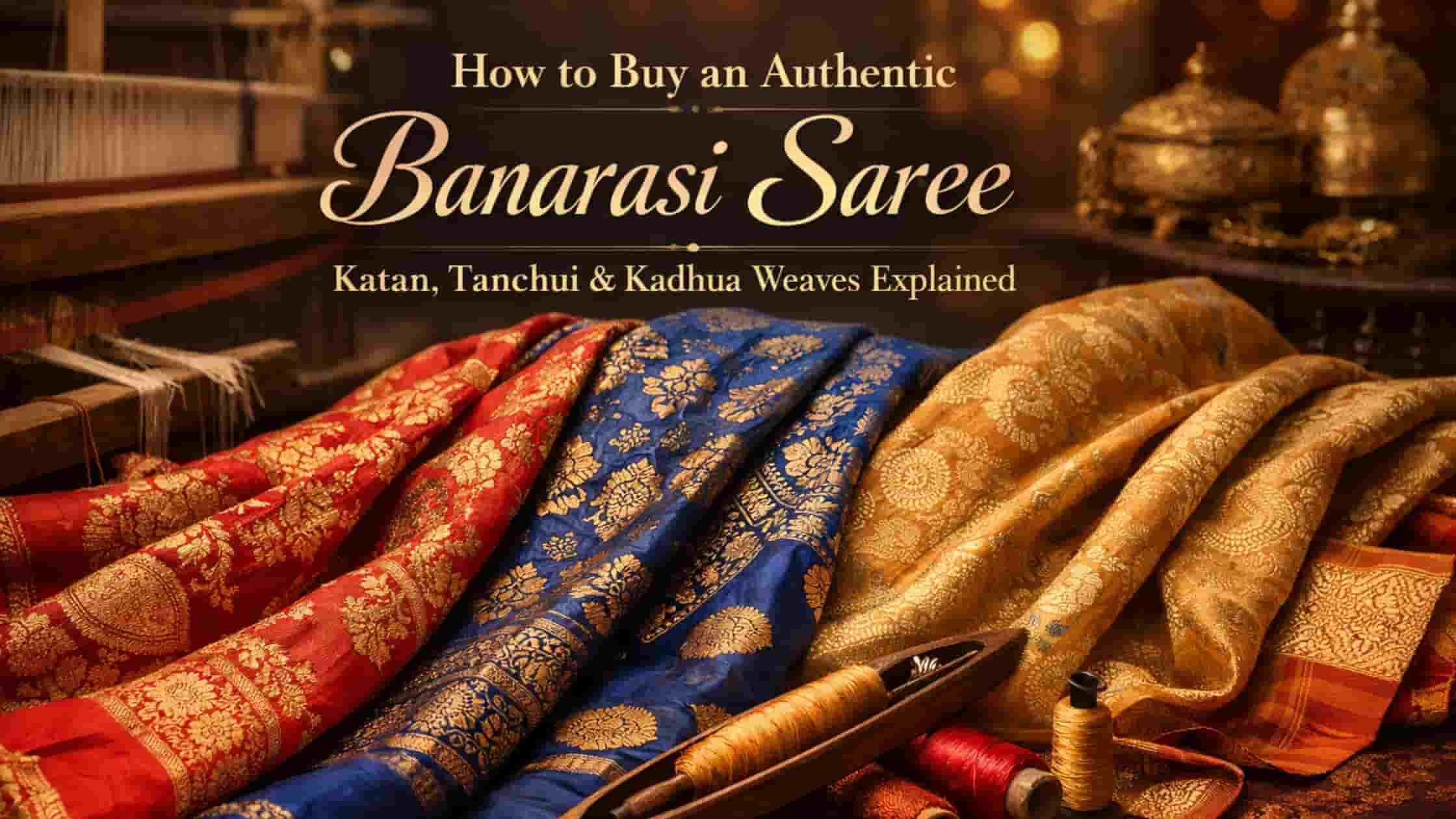
This guide is not just about spotting fakes. It is about understanding what you are actually choosing between — because an authentic Banarasi saree is not one thing. It is a family of distinct weaves, each with its own character, occasion, and price. Once you understand the difference between a Katan silk, a Tanchui, and a Kadhua weave, you will not only buy better — you will wear your saree differently.
What Makes a Banarasi Saree Truly Banarasi?
A Banarasi saree earns its name from Varanasi — formerly Banaras — in Uttar Pradesh, India. The craft traces its roots to the Mughal period, when Persian floral motifs, gold and silver zari work, and fine silk weaving merged with Indian textile traditions to create something entirely new and entirely extraordinary.
What defines an authentic Banarasi saree is the combination of three non-negotiable elements:
Pure natural silk — not art silk, not polyester blends, not semi-silk. Genuine Banarasi sarees are woven from mulberry silk, the finest grade available, known for its natural lustre, cool drape, and the way it holds the weight of zari without fraying.
Real zari — threads of real gold or silver wrapped around a silk or copper core. Authentic zari is heavier than it looks, develops a gentle patina with age, and never loses its integrity. Imitation zari is plastic-coated and metallic in a brash, uniform way that real zari never is.
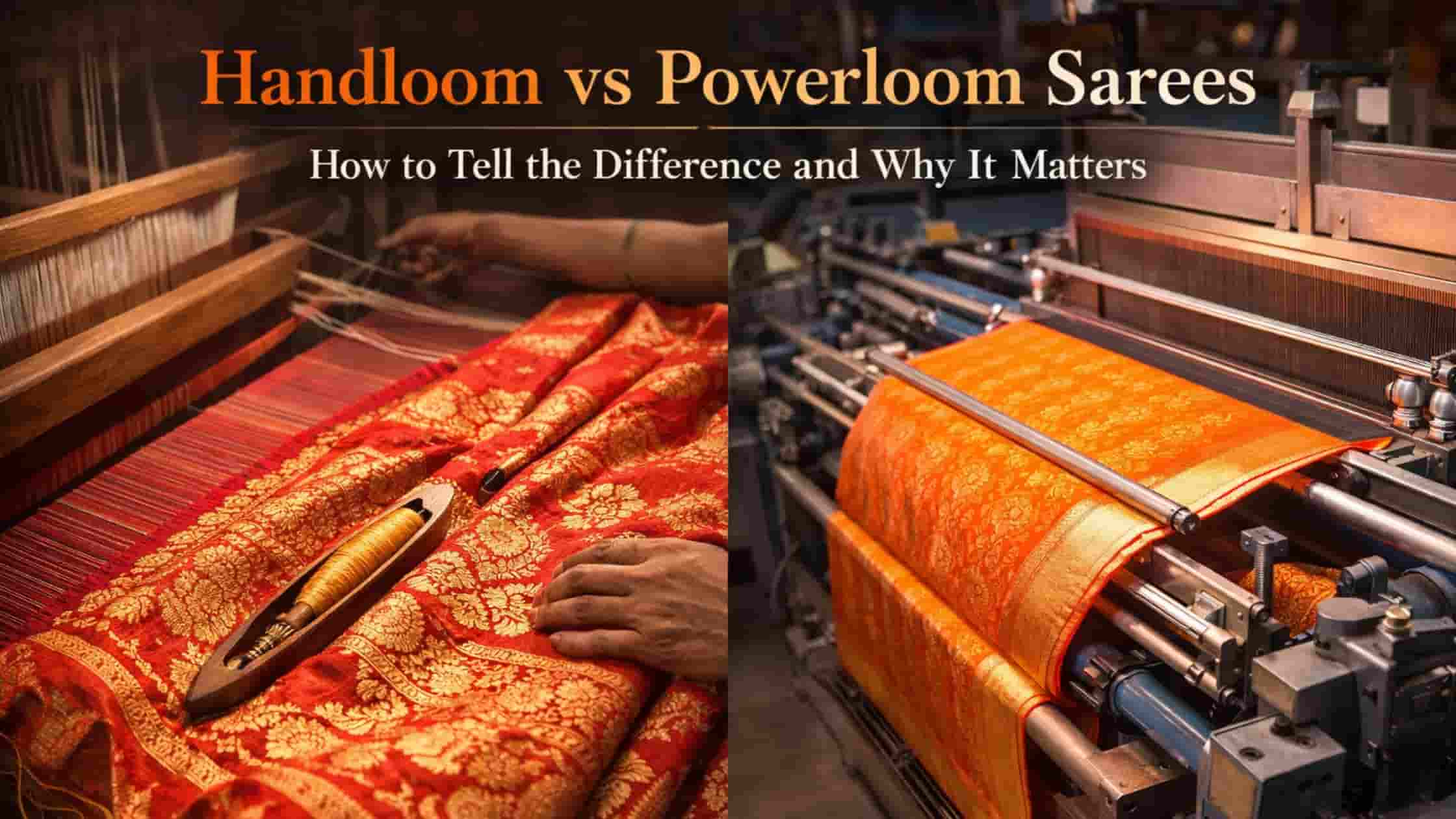
Handloom weaving in Varanasi — by skilled artisans using traditional pit looms or frame looms, following patterns that can take weeks or months to complete. The handloom process introduces the small imperfections — the thread joins, the slight asymmetries, the natural variation in density — that are not flaws but fingerprints of the craft.
The Three Weaves You Must Know Before Buying
This is where most buying guides stop short. They tell you how to spot a fake, but they do not tell you what the real options actually are. An authentic Banarasi saree comes in several distinct weave types, and the one you choose matters enormously — for how the saree drapes, how it feels on the body, what occasion it suits, and what it costs.
Katan Silk — The Purest Expression of Banarasi Craft
Katan is the foundation. If any single weave defines the Banarasi tradition at its most classical and opulent, it is Katan.
The word Katan refers to a tightly twisted, pure mulberry silk yarn. Sarees woven in Katan silk are dense, structured, and heavy with an unmistakable depth of sheen. The silk does not shimmer cheaply — it glows, with the kind of depth that changes in different light. Katan is the silk of bridal trousseaus, of women who want a saree that makes an entrance and becomes an heirloom.
Katan silk Banarasi sarees typically bear the most intricate zari work — Jaal patterns that cover the entire body, or elaborate Buta motifs in fine gold zari across the field, with a broad, heavily worked pallu and contrast borders. The weave is reversible in its finest form: the back of a true Katan silk Banarasi is almost as beautiful as the front.
Who should choose Katan: Brides and those attending grand weddings or formal festive occasions. Katan is not for the faint-hearted — or the warm weather. It has weight, presence, and demands to be dressed up to.
Price signal: Genuine Katan silk Banarasi sarees begin at approximately ₹15,000 and can exceed ₹1,00,000 for heavily worked pieces with pure gold zari. Any price significantly below this range should be questioned.
Tanchui — The Weave of Colour and Resham
If Katan is opulence, Tanchui is poetry.
Tanchui is a weaving technique, not just a fabric. The name is derived from a Chinese silk weaving style that arrived in Varanasi centuries ago and was entirely reimagined by Banarasi weavers. What makes Tanchui distinctive is the use of multiple coloured silk threads — called Resham — woven simultaneously into the body of the saree to create intricate multi-tonal patterns without the heaviness of gold zari.
The result is a saree that appears almost embroidered but is entirely woven — every flower, every vine, every motif is formed by the loom. Tanchui sarees are lighter than Katan, softer in appearance, and extraordinarily rich in colour. They typically come in deep, saturated tones — crimson, deep magenta, forest green, indigo — with patterns that seem to emerge from within the silk itself.
Because Tanchui uses Resham silk rather than metallic zari as its primary decorative element, these sarees have a more textile richness than metallic shine. They are appropriate for a wider range of occasions — grand enough for weddings, refined enough for festive evenings that do not call for full bridal weight.
Who should choose Tanchui: Women who love colour over metallic drama, or those who want a saree that is clearly special but slightly more wearable than a full bridal Katan. Tanchui is also an exceptional trousseau choice for functions other than the main wedding ceremony.
What to look for: On a genuine Tanchui, turn the saree to the reverse. You will see the coloured Resham threads floating at the back — long, fine horizontal trails of silk in the same hues as the pattern on the front. This is characteristic and authentic. A machine-made imitation will have a flat, uniform back.
Kadhua (Kadwa) — The Mark of True Handloom Mastery
Kadhua is not a fabric type — it is a weaving technique, and it is the most labour-intensive one in the Banarasi tradition.
In Kadhua weaving, each individual motif on the saree — every flower, every paisley, every buta — is woven separately by the artisan using a small separate shuttle, rather than the entire pattern being woven in a single pass across the loom. The result is motifs that are clean, sharp, three-dimensional in feel, and entirely without loose threads at the back. A genuine Kadhua Banarasi saree has a back side that is almost as neat as the front — sometimes described as reversible — because no threads need to be cut or float freely.
Kadhua is often confused with Cutwork (also called Phekwa), which is faster and cheaper. In Cutwork, the pattern threads run across the full width of the saree and are cut away at the back. This leaves small loose threads behind each motif on the reverse — which is a tell-tale sign of Cutwork rather than Kadhua. Both are authentic handloom techniques, but Kadhua commands a higher price and a longer weaving time, sometimes several months for a single saree.
Who should choose Kadhua: Collectors, connoisseurs, and anyone seeking a saree as a genuine heirloom investment. Kadhua weaves are found across Katan, Organza, and other silk bases — it is a mark of technique rather than fabric.
How to verify: Run a finger across the reverse of the saree along a motif. Kadhua will feel smooth and clean, with no floating threads. Cutwork will have small thread ends tucked or visible. Both are authentic; knowing the difference simply helps you understand what you are paying for.
Other Authentic Banarasi Weaves Worth Knowing
Beyond Katan, Tanchui, and Kadhua, the Banarasi tradition includes several other weave variants that deserve recognition:
Organza (Kora) Banarasi — woven from the raw silk fibre before it is processed into Katan, Organza Banarasi sarees are sheer, stiff, and ethereally light. The translucent base contrasts dramatically with heavy zari work, creating a saree that is paradoxically delicate and grand at the same time. Increasingly popular for contemporary bridal looks and evening wear.
Georgette Banarasi (Khaddi Georgette) — a pure silk georgette base with traditional Banarasi zari weaving. Far lighter than Katan, it drapes fluidly and is the Banarasi saree for those who love the craft but want something they can wear more often. The twist of the silk yarn gives it a slight crinkle and exceptional drape.
Tissue Banarasi — woven with gold or silver zari as the base thread rather than silk, creating a saree that is literally metallic in its ground cloth. Tissue Banarasi sarees have a distinctive shimmer and stiffness. They are grand but require careful handling.
How to Verify Authenticity: The Marks That Matter
The GI Tag
The Geographical Indication (GI) tag is the government's official certification that a Banarasi saree was handwoven in the Varanasi region using traditional methods. It carries a unique serial number and hologram. Always ask for it. Its absence does not automatically mean a saree is fake, but its presence is the strongest guarantee available.
The Silk Mark
Issued by the Silk Mark Organisation of India, the Silk Mark certifies that the saree is made from 100% pure silk. Many Silk Mark labels now carry a QR code you can scan to verify on the spot. If a seller is reluctant to show certification, that hesitation is itself informative.
The Reverse Side Test
Turn the saree over and examine the back. A genuine handloom Banarasi will show slight thread joins, colour variations, and in the case of Tanchui and Cutwork, characteristic floating threads. A power-loom imitation will have a flat, machine-perfect finish with no variation. Irregularity on the reverse is a sign of authenticity, not a defect.
The Zari Test
Real zari has a soft, warm, slightly muted glow — not a sharp metallic flash. Rub the zari gently between two fingers. Authentic zari will maintain its sheen and feel slightly rough due to the metal content. Imitation zari will look dull or show a grey undertone after rubbing, and may feel plasticky or too smooth.
The Feel of Pure Silk
Pure mulberry silk is cool to the touch and has a slight natural grip — it does not slip through the fingers like synthetic fabric. It is heavier than you expect for its apparent fineness. Rub a fold of the silk briskly between your palms: genuine silk warms noticeably from the friction. Synthetic fabric does not.
The Price Reality
A genuine handwoven Banarasi saree — made with pure silk, real zari, and taking weeks of artisan labour — cannot honestly be sold for ₹3,000. A legitimate Banarasi begins at approximately ₹8,000–₹12,000 for simpler pieces and rises significantly with the complexity of the weave, the purity of the zari, and the intricacy of the pattern. A price that seems too good to be true is, without exception, too good to be true.
Traditional Motifs: The Language of the Loom
Authentic Banarasi sarees speak through their motifs — and knowing them deepens your relationship with what you are wearing.
Jaal — an all-over lattice or net pattern, often in fine gold zari, covering the entire field of the saree. One of the most iconic Banarasi patterns, associated with Mughal garden aesthetics.
Buta / Buti — individual flowering motifs scattered across the body of the saree. Buta refers to larger motifs; Buti to smaller ones. Both are woven, never printed.
Kalga — a paisley or mango-shaped motif. One of the oldest motifs in the Banarasi tradition, derived from Persian design.
Bel — a flowing vine pattern, typically used along borders. Often combined with Kalga in the pallu to create the classic Banarasi border composition.
Shikargah — a hunting scene motif, featuring animals, foliage, and royal scenes. Among the most elaborate and prestigious of Banarasi patterns.
Jangla — dense, jungle-like patterns covering the entire saree body with intertwining foliage and flowers. A Jangla Banarasi is one of the most complex and time-consuming to weave.
A Note on Buying Online
Buying a Banarasi saree online requires additional care, but it is entirely possible to do so confidently if you know what to look for in a seller.
Seek brands that disclose their silk type (Katan, Georgette, Organza), weaving technique (Kadhua, Tanchui, Cutwork), and zari composition clearly in their product descriptions. A brand that knows its craft will name these things without prompting because they are proud of them.
Request close-up images of the reverse side of the saree — this single ask will tell you a great deal about the seller's confidence in their product. Look for Silk Mark certification displayed on the product page, and for brands that source directly from Varanasi artisans or work closely with weaving communities.
At Smira, every Banarasi saree we carry is described by its specific weave, its silk base, and its zari composition — because we believe that when you understand what you are choosing between, you do not just buy a saree. You choose an heirloom.
Explore Smira's Banarasi Saree Collection →
Frequently Asked Questions
What is the difference between a Katan and a Tanchui Banarasi saree?
Katan is a fabric — a tightly woven pure mulberry silk that is dense and lustrous, typically worked with gold zari. Tanchui is a weaving technique that uses multiple coloured silk (Resham) threads woven simultaneously to create multi-tonal patterns. A Tanchui saree is lighter and more colour-forward than a Katan, and suited to a wider range of occasions.
What is Kadhua weave and why does it cost more?
Kadhua (also spelled Kadwa) is a handweaving technique in which each individual motif is woven separately using its own shuttle, resulting in a clean, thread-free reverse side. It is significantly more labour-intensive than Cutwork, where pattern threads span the full width and are trimmed away. Kadhua weaving can take weeks to months for a single saree, which is reflected in its price.
How do I know if the zari in a Banarasi saree is real?
Real zari has a warm, slightly muted glow rather than a sharp metallic shine. Rub it gently between two fingers — authentic zari holds its sheen and feels slightly textured. Imitation zari dulls, shows a grey or brassy tint, and may feel plasticky. Real zari also has natural weight and will not flake or peel over time.
What does the GI tag on a Banarasi saree mean?
The Geographical Indication (GI) tag is a government-issued certification that guarantees the saree was handwoven in Varanasi using traditional methods. Only sarees from this region and process are legally entitled to bear the Banarasi name. The tag includes a unique serial number and hologram for verification.
What is a reasonable price for a genuine Banarasi saree?
Authentic handwoven Banarasi sarees begin at approximately ₹8,000–₹12,000 for simpler pieces with limited zari work. More elaborate weaves with pure zari, Kadhua technique, or Katan silk base start from ₹20,000 and can reach ₹1,00,000 or more. Any Banarasi saree claiming full authenticity at well below ₹8,000 should be approached with significant scepticism.
Can I wash a Banarasi saree at home?
No. Banarasi sarees with pure silk and real zari should always be dry cleaned. Water can damage the zari and strip the natural sizing from the silk. Store your saree folded in a soft muslin cloth in a cool, dry place, away from direct sunlight and plastic covers. Refold gently every few months to prevent stress lines at the fold points.
Is a Banarasi saree suitable for everyday wear?
Pure Katan and heavily zari-worked Banarasi sarees are best reserved for special occasions. However, lighter Banarasi weaves — particularly Georgette Banarasi and simpler Organza pieces — can be worn for festive office days, evening events, or family celebrations without being overdressed. Choose the weave to match the occasion.
At Smira, we curate handcrafted Banarasi sarees in pure natural fabrics — every piece selected for the integrity of its weave, the authenticity of its craft, and the story it carries. Explore our Banarasi collection to find a saree that is truly yours.