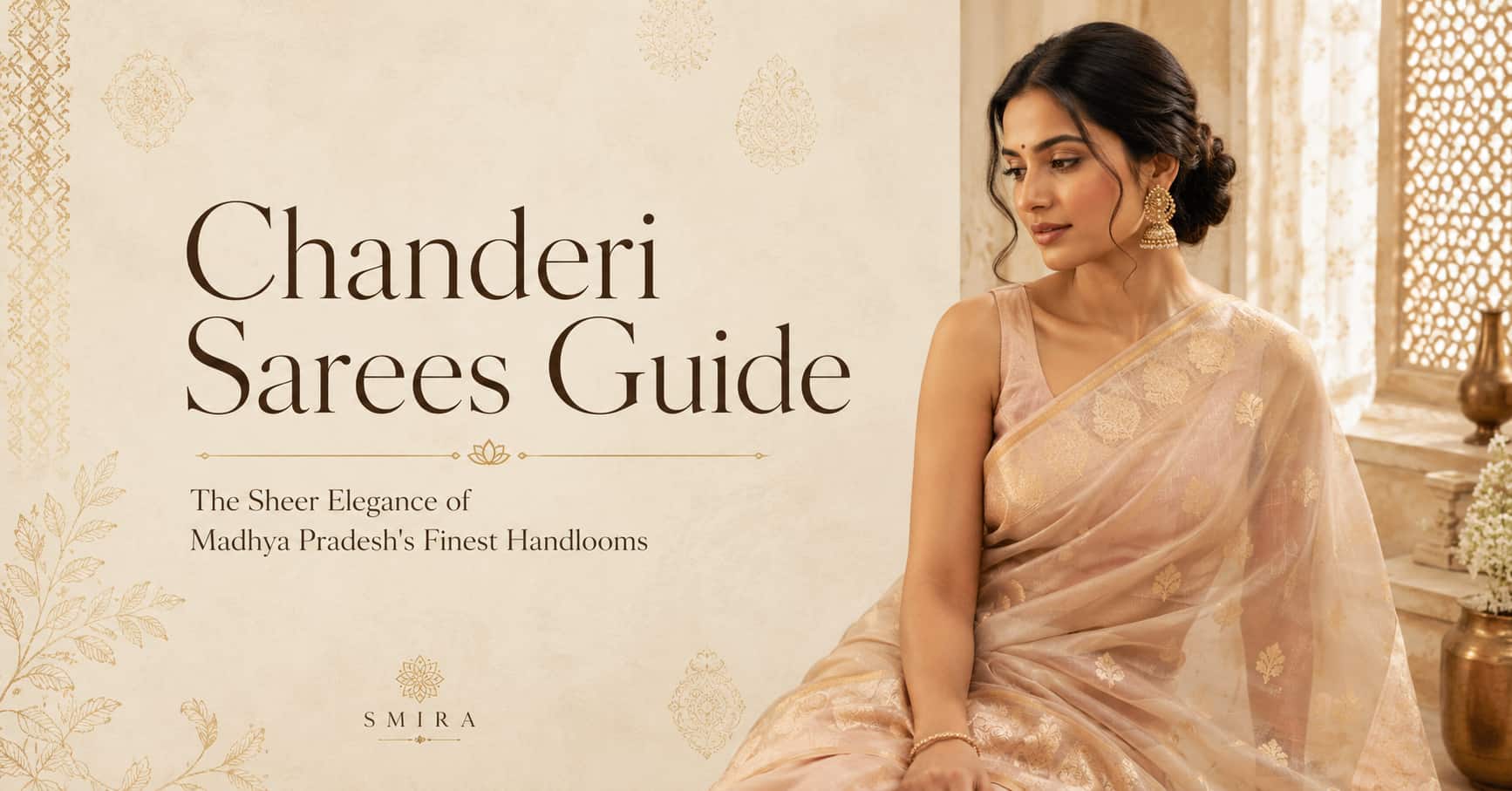
Chanderi Sarees Guide: The Sheer Elegance of Madhya Pradesh's Finest Handlooms
Key Takeaways
Choose a Chanderi saree online by checking proof, fabric behavior, occasion fit, and care needs before color or price.
-
Before buying a Chanderi saree online, check fabric composition, weave transparency, motif detail, zari finish, seller information, return terms, and care instructions.
-
Silk Chanderi suits richer festive dressing, cotton Chanderi works for breathable daytime wear, and silk-cotton Chanderi is often the most versatile first purchase.
-
Sheer texture gives Chanderi its refined look, so blouse, petticoat, lining, and draping choices matter.
-
Handloom, pure silk, GI, artisan-made, and provenance claims need seller documentation, not only attractive photos.
-
Long-term satisfaction depends on careful cleaning, soft storage, and protection from snags, moisture, and harsh ironing.
What is a Chanderi saree?
Chanderi saree, known for its airy fall and quiet sheen, is a lightweight Indian saree associated with Chanderi in Madhya Pradesh. Textile identity comes from both the weaving tradition and the finished saree style.
Fine yarns and an open weave create the sheer appearance. Reduced bulk allows softer pleats, so the saree feels dressy without the heaviness of many formal silks.
Online shoppers should read Chanderi as a fabric and weave category, not just a visual label. Once that identity is clear, heritage claims and product details become easier to judge with care.
Why is Chanderi associated with Madhya Pradesh handloom heritage?
Chanderi is widely associated with Madhya Pradesh because Chanderi town is a long-recognized weaving center. Precise claims about age, royal patronage, or historic origin should be verified before publishing or buying.
Handloom value appears through weave variation, motif placement, and a finish shaped by craft rather than only machine consistency. Such details affect both visual character and buyer trust.
Heritage adds meaning, but product-level proof still decides whether an online listing deserves confidence. Next, fabric behavior explains why Chanderi looks and wears differently from heavier sarees.
What makes Chanderi fabric sheer, light, and elegant?
Chanderi’s signature look comes from the relationship between fine yarns, open texture, and surface sheen.
Fine yarns
Fine yarns give Chanderi fabric its delicate handfeel and reduce bulk across the saree. Lower yarn density allows pleats to settle without feeling thick at the waist.
Buyer impact appears during long events, where lighter fabric allows easier movement. Dressy presence comes from refined texture rather than heavy embroidery alone.
Open texture
Open texture creates the sheer appearance many buyers associate with Chanderi. Visible light through the weave gives the fabric its airy quality.
Practical choices follow from that transparency. Petticoat color, blouse opacity, lining needs, and daylight wear deserve attention before checkout.
Subtle sheen
Subtle sheen gives Chanderi a polished finish without needing dense zari or heavy embellishment. Silk content, weave, and finishing influence how strongly the fabric catches light.
Occasion fit changes with shine level. Gentle glow can suit office or puja wear, while stronger shine and metallic borders move the saree toward festive dressing.
Which types of Chanderi sarees can you buy online?
Compare Chanderi types by look, comfort, formality, and the product details worth checking before checkout.
| Type | Look and feel | Best for | Buying note |
|---|---|---|---|
| Silk Chanderi | Smoother shine, richer drape, more formal finish | Weddings, receptions, festive evenings | Verify whether the listing says pure silk, silk blend, or silk-marked fabric if that claim matters |
| Cotton Chanderi | Crisper texture, breathable feel, softer sheen | Office wear, pujas, summer gatherings, daytime events | Check transparency, blouse pairing, and whether the saree needs lining or an opaque petticoat |
| Silk-cotton Chanderi | Balanced sheen, manageable drape, versatile mood | First-time buyers, gifting, semi-formal occasions | Often the most practical online choice when fabric details and return terms are clear |
| Designer Chanderi | Contemporary colors, heavier borders, styled motifs, mixed embellishment | Statement events, modern festive dressing | Read composition carefully because “designer” describes styling, not fabric purity or handloom status |
How do you identify a good Chanderi saree online?
Judge the listing by what it proves, not only by how appealing the photos look.
-
Fabric details: Look for yarn composition, saree length, blouse piece details, width, and care instructions.
-
Close-up photos: Check weave texture, border finish, pallu detail, and daylight transparency.
-
Motif clarity: Prefer visible butti, floral, peacock, coin, geometric, or temple motifs with clear placement.
-
Zari finish: Inspect whether gold or silver zari looks neat, balanced, and suitable for the intended occasion.
-
Seller proof: Look for provenance notes, handloom documentation, artisan or cluster details, and clear support channels when such claims are made.
-
Return terms: Confirm exchange, return, color variation, defect reporting, and delivery policies before payment.
Which Chanderi saree is right for your occasion?
Match fabric blend, motif density, zari weight, and transparency to the setting before choosing color.
-
Wedding events: Choose silk Chanderi or zari-bordered silk-cotton Chanderi for sheen, richer borders, and a more formal pallu.
-
Day functions: Pick cotton or silk-cotton Chanderi in lighter colors, smaller motifs, and breathable styling.
-
Office wear: Select minimal zari, crisp pleats, quieter motifs, and structured blouse fabrics for a polished but restrained look.
-
Puja dressing: Consider pastel cotton Chanderi or subtle silk-cotton options with traditional borders and comfortable drape.
-
Gifting choice: Choose silk-cotton Chanderi when the recipient’s style, climate, or occasion needs are uncertain.
What motifs and borders should you look for?
Motifs shape the visual mood of a Chanderi saree more than many buyers realize. Small butti patterns usually feel restrained, while peacock, floral, coin, geometric, or temple-inspired designs create a more festive or heritage-led look.
Border width changes formality. Slim borders keep the look light for daytime wear, while broader zari borders and detailed pallus suit weddings, receptions, or gifting.
Online buying gets easier when motif density, border scale, and fabric type are read together. Delicate motifs on cotton Chanderi may work for office or puja wear, while stronger zari on silk Chanderi often belongs in a festive wardrobe.
How should you style a Chanderi saree without making it look overdone?
Let one element carry the look: blouse texture, jewellery, border, or drape finish.
Blouse pairing
Blouse choice decides how sheer Chanderi appears on the body and how formal the saree feels. Opaque fabric makes the drape easier to wear in daylight.
Contrast colors, elbow sleeves, and subtle woven textures add structure without hiding the saree’s airy character. With delicate borders, a plain blouse often looks cleaner than heavy embroidery.
Jewellery balance
Jewellery should respond to zari and motif density rather than compete with them. Minimal borders usually pair well with fine metallic pieces or one focused accessory.
Festive pallus and richer silk sheen can carry heavier earrings or bangles. Balanced styling keeps the saree refined instead of crowded.
Draping finish
Draping finish affects whether the saree looks crisp, soft, formal, or relaxed. Sharper pleats support office and puja dressing because they control the airy fabric.
Softer pallu falls work well for evening events where movement and sheen matter. Secure pins carefully so fine yarns do not snag.
How do you care for a Chanderi saree after buying it?
Protect the weave, zari, and sheer texture by treating Chanderi as a delicate textile from the first wear.
-
Cleaning method: Follow the care label, and prefer professional cleaning when the saree has silk, zari, or delicate embellishment.
-
Storage fold: Store clean and dry with soft folds, then refold occasionally to reduce deep crease stress.
-
Zari care: Keep metallic borders away from moisture, perfume, and rough surfaces that can dull or snag the finish.
-
Ironing caution: Use low heat, a protective cloth, and careful pressure so fine yarns and zari stay intact.
-
Wear rotation: Avoid repeated heavy use without rest, especially for sheer or zari-rich sarees.
What should you verify before buying a Chanderi saree online?
Use this risk check before paying for any listing with premium, handloom, or purity claims.
| Claim or detail | What to check before buying |
|---|---|
| Handloom | Seller documentation, weave close-ups, artisan or cluster information, and return support |
| Pure silk | Stated composition, certification if offered, and clarity on whether silk is in warp, weft, or both |
| GI or provenance | Source documentation and cautious seller wording, not only heritage language |
| Artisan-made | Named process details, maker information, or brand transparency where available |
| Return policy | Return window, exchange rules, defect handling, and color mismatch policy |
| Color accuracy | Daylight photos, close-ups, video if available, and disclosure about screen variation |
Which buying signals should guide your online Chanderi saree decision?
Decision quality improves when each listing is scored against visible proof, practical fit, and post-purchase care needs.
| Decision signal | What strong evidence looks like | Why it matters |
|---|---|---|
| Fabric clarity | Composition, blend, dimensions, blouse details, care label | Prevents mismatch between expected drape and delivered fabric |
| Visual proof | Full saree image, close-up weave, pallu, border, worn photo | Reduces uncertainty around transparency, motif scale, and finish |
| Occasion fit | Styling cues for wedding, puja, office, or gifting | Prevents buying a saree that feels too plain or too ornate |
| Seller trust | Provenance notes, support access, reviews, return terms | Lowers risk when handfeel cannot be checked before purchase |
| Care readiness | Cleaning, storage, and ironing guidance | Protects fine yarns, zari, and sheer texture after delivery |
| Claim verification | Proof for handloom, pure silk, GI, or artisan-made claims | Keeps heritage appreciation separate from unsupported product claims |
How should you choose a Chanderi saree online?
Now that fabric, design, and proof signals are clear, choose by use case first, then narrow by blend, opacity, motif, seller disclosure, care needs, and return safety.
-
Fabric blend: Pick silk for richer shine, cotton for breathable daytime wear, and silk-cotton for balanced versatility.
-
Opacity needs: Check whether the sheer weave requires a specific petticoat, lining, or blouse structure.
-
Occasion level: Match zari, border width, pallu detail, and motif density to the event’s formality.
-
Seller disclosure: Favor listings with fabric composition, dimensions, close-ups, provenance notes, and responsive support.
-
Care commitment: Avoid highly delicate or zari-heavy options if regular maintenance, careful storage, or dry cleaning feels impractical.
-
Return safety: Prioritize sellers with clear return, exchange, color variation, and defect policies.
How can product pages make Chanderi saree shopping easier?
Strong product pages help buyers compare Chanderi sarees by fabric type, occasion, and proof points rather than only by color or discount.
-
Useful filters: Include silk, cotton, silk-cotton, zari, pastel shades, festive wear, office wear, and puja wear.
-
Specific examples: Show use cases such as “pastel cotton Chanderi for daytime puja” or “zari-bordered silk Chanderi for a wedding reception.”
-
Image prompts: Provide close-ups for weave, motif, pallu, border, and blouse fabric.
-
Care placement: Keep cleaning, storage, and ironing guidance near fabric composition.
-
Claim restraint: Avoid “best,” “guaranteed pure,” “most authentic,” or “investment piece” unless proof is shown.
Is a Chanderi saree worth buying online?
Yes, a Chanderi saree is worth buying online when seller disclosure is strong and the buyer chooses by fabric type, occasion, transparency, and care readiness. Confidence comes from comparing evidence, not from relying on polished photos alone.
For festive richness, choose silk Chanderi with verified composition and suitable zari. For breathable daytime wear, choose cotton Chanderi, and for the broadest first purchase, choose silk-cotton.
Before checkout, compare fabric details, close-up images, return policy, and proof for any handloom or purity claim. Better buying decisions begin with use case and verification, then move to color, border, and final styling.
Why is Smira a good choice for buying Chanderi sarees online?
Smira is a strong choice for buying Chanderi sarees online when you want a saree that feels premium, elegant, and easy to evaluate before purchase. The collection is designed for buyers who care about fabric quality, refined styling, and occasion-ready ethnic wear rather than only discounts or trend-led designs.
For Chanderi saree shoppers, Smira helps make the buying decision easier by focusing on graceful colors, wearable designs, and sarees that suit festive events, pujas, family gatherings, and elevated daytime dressing. This is especially useful when choosing Chanderi online, where fabric behavior, transparency, border detail, and overall styling need to feel trustworthy from the product presentation.
Smira also works well for buyers looking for a more curated ethnic wear experience. Instead of browsing through endless generic listings, shoppers can explore sarees that feel thoughtfully selected for modern Indian wardrobes while still carrying the charm of traditional handloom-inspired dressing.
FAQs
Is Chanderi silk the same as pure silk?
No. Chanderi describes a weaving tradition or fabric style, while silk refers to yarn composition, so listings should state whether the saree is pure silk, cotton, or silk-cotton.
Is Chanderi suitable for summer weddings?
Many Chanderi sarees work well for warm-weather events because the drape is light, but zari, color, and fabric blend decide how formal the saree feels.
Are Chanderi sarees transparent?
Yes, Chanderi is known for a sheer look, so petticoat color, blouse opacity, and draping style should be planned before wearing it.
How can I tell if a Chanderi saree is handloom?
Check seller proof, close-up weave photos, provenance information, and return terms. No single visual sign should be treated as complete proof of handloom authenticity.
Which Chanderi saree is best for first-time buyers?
Silk-cotton Chanderi is often the strongest first online choice because it balances sheen, comfort, drape, and occasion flexibility.
Can Chanderi sarees be worn for office wear?
Yes, cotton Chanderi or subtle silk-cotton Chanderi can work for office wear when the zari is minimal and the blouse is structured.
How should Chanderi sarees be stored?
Store Chanderi sarees clean and dry with soft folds, breathable fabric covers, and careful handling around zari borders.